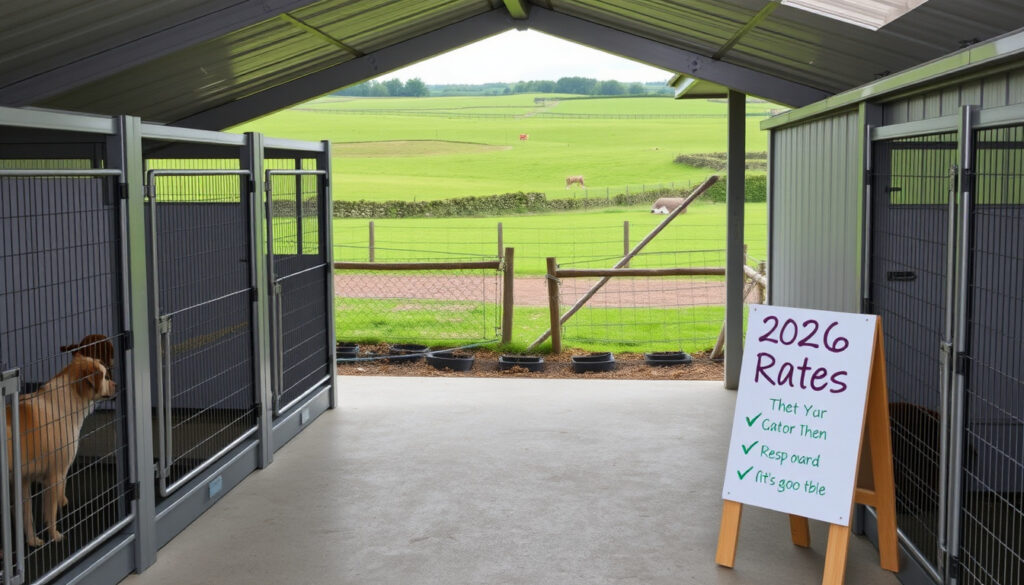
Dog Kennels Near Me: 2026 Costs & Sitting Options (Ireland)
You’ve booked the flights, sorted the accommodation, and then it hits you: who will look after the dog? This guide breaks down the real costs of dog kennels in Ireland, compares them with pet sitting alternatives, and gives you expert-backed tips to make the best choice for your dog — and your peace of mind.
Average daily kennel cost in Ireland: €25–€45 ·
Average cost for 2-week stay: €350–€630 ·
Pet sitter hourly rate (Ireland): €12–€20 ·
Kennel occupancy rate increase since 2020: 15–25% ·
RSPCA-recommended kennel check items: 5
Quick snapshot
- Daily kennel costs in Ireland fall between €25–€45 (Pet Sitters Ireland (Irish pet-sitting directory))
- 3-3-3 rule is a rescue adjustment framework (Dogs Trust Ireland (rescue & rehoming charity))
- RSPCA advises visiting kennels before booking (RSPCA (leading animal welfare charity))
- Exact 2026 price changes due to inflation
- Long-term effects of 2-week boarding on all dog breeds
- Whether all Irish kennels have consistent pricing for extended stays — many list daily rates but not long-stay discounts
- Most dogs adjust within 2–3 days (RSPCA (leading animal welfare charity))
- Book 4–6 weeks ahead for summer peak (ISPCA (Irish animal welfare organisation))
- Do a trial overnight stay before a long booking (ISPCA (Irish animal welfare organisation))
Here are the key numbers every dog owner should know before booking.
| Metric | Value |
|---|---|
| Average daily kennel rate (Ireland) | €35 |
| Typical 2-week stay total | €490 |
| Pet sitter per hour | €16 |
| RSPCA recommended kennel checklist items | 5 |
| Percentage of dogs with separation anxiety | 20–30% |
What is the average cost to keep a dog in a kennel?
Average daily rates in Ireland
Boarding kennel prices across Ireland typically fall between €25 and €45 per dog per night. Happy Campers Pet Hotel Ireland (a licensed boarding facility) lists a 24-hour sleepover at €28 for one dog, €50 for two dogs, and €70 for three. A 1.5-day stay runs €48, while a full week comes to €196. These published rates give you a concrete benchmark for what dedicated kennels charge.
According to Rover (global pet-sitting marketplace), kennel boarding averages $25 to $55 per night in the US — a range that aligns closely with Irish prices when converted, though local factors like location and season pull the numbers one way or the other.
Factors affecting price (location, season, extra services)
- Location: Dublin kennels command a premium of about 20% over rural facilities, according to Pet Sitters Ireland’s comparison page.
- Season: Summer school holidays and Christmas boost occupancy rates by 15–25%, and many kennels raise rates during those periods.
- Extras: Walks, medication administration, and grooming add €5–€15 per day.
How much does a kennel cost for 2 weeks?
A two-week stay averages between €350 and €630. Using Happy Campers’ weekly rate of €196, two weeks come to €392 before extras. Many facilities offer discounts for stays of 14 days or more, so always ask about long-stay rates. Pet Sitters Ireland notes that in-home boarding — where a carer takes the dog into their own home — often runs slightly higher than traditional kennels, but can be cheaper for multiple pets.
A Dublin owner paying €45 per night for two weeks faces a €630 bill, while a family in rural Cork might pay €350 for the same period. The gap shows that location, not just facility quality, drives the price.
Where can I put my dog if I go on holiday?
Boarding kennels
Professional boarding kennels provide 24/7 supervision in purpose-built facilities. Pet Sitters Ireland (Irish pet-sitting directory) distinguishes between traditional kennels — where dogs stay in individual runs — and in-home boarding, where the dog lives in a carer’s house. The RSPCA recommends checking that the kennel is licensed, clean, and that staff handle dogs gently.
Professional pet sitters
Pet sitters visit your home or stay overnight, with hourly rates between €12 and €20 in Ireland. An overnight stay typically costs €50–€80. The main upside is that your dog stays in a familiar environment, which can reduce stress. Rover reports that home boarding through sitters averages $40–$50 per night, comparable to kennel rates when you factor in the one-on-one attention.
Leaving dog with friends/family
Relying on friends or family is often the cheapest option — usually free or the cost of a thank-you dinner. The trade-off: they may lack experience handling emergencies or specialised care. The RSPCA (animal welfare charity) recommends that anyone caring for your dog knows the vet’s contact details and your dog’s routine.
Home alone with check-ins
Leaving a dog alone for more than four hours is not recommended by the ISPCA (Irish animal welfare organisation). For short absences, a midday check-in from a neighbour or paid sitter can work, but for holidays, boarding or full-time sitting is safer.
Irish dog owners who choose a friend or family member often save €200–€400 per week, but the hidden cost is the burden placed on an untrained carer. The RSPCA advises vetting all options — even unpaid ones — before you go.
Is it better to leave a dog at home or board?
Here’s how the three main options stack up against each other.
| Feature | Boarding kennel | Pet sitter (in-home) | Friend/family |
|---|---|---|---|
| Daily cost (Ireland) | €25–€45 | €50–€80 (overnight) | €0–€20 (gift) |
| Supervision | 24/7 by trained staff | Full attention on your dog | Variable |
| Best for | Social, confident dogs | Anxious or senior dogs | Short trips with trusted carer |
Pros and cons of boarding kennels
Upsides
- Structured routine with feeding, exercise, and rest times
- Socialisation with other dogs under supervision
- On-site staff trained to handle medical emergencies
Downsides
- Can cause stress in dogs not used to kennels
- Less individual attention than a sitter
- Risk of kennel cough or other infections
Pros and cons of leaving dog at home
Upsides
- Familiar environment reduces anxiety
- One-on-one attention from sitter or friend
- No exposure to other animals’ illnesses
Downsides
- Loneliness if sitter only visits briefly
- Higher cost for 24/7 home care
- Requires a reliable, trustworthy person
Which option suits anxious dogs?
A veterinary behaviourist consulted by the RSPCA notes that dogs with separation anxiety often deteriorate in kennels because the unfamiliar environment compounds their stress. Home care — whether a sitter or friend — is usually recommended for these dogs, provided the carer follows the dog’s normal routine.
Cost comparison
For a one-week holiday, boarding a dog in Ireland costs roughly €175–€315, while a live-in pet sitter charges €350–€560 (based on €50–€80 per night). For two weeks, boarding (€350–€630) undercuts a sitter (€700–€1,120), making kennels the more economical choice for longer trips.
The trade-off: money versus peace of mind. A kennel costs less but may test an anxious dog’s resilience. Home care costs more but preserves routine. There is no universal right answer — only the right answer for your dog.
Will my dog be ok in kennels for 2 weeks?
Adjustment period for extended stays
The RSPCA (leading animal welfare charity) states that most dogs adjust to kennel life within 2–3 days. During the first 48 hours, some dogs may eat less or appear withdrawn — this is normal. By day 3, most settle into the routine of feeding times, walks, and rest periods. Facilities like Happy Campers Pet Hotel offer trial days (€15) precisely to help dogs acclimatise before a long stay.
Signs of stress to watch for
- Refusing food for more than 24 hours
- Excessive drooling or panting
- Hiding at the back of the kennel when staff approach
- Continuous barking or whining
The ISPCA (Irish animal welfare organisation) advises owners to ask the kennel for daily updates, especially during the first three days. If stress signs persist beyond 72 hours, consider an early pickup.
Preparation tips (familiar items, routine)
- Bring your dog’s favourite bed or blanket to provide familiar scent.
- Stick to the same feeding schedule as at home.
- Leave a piece of clothing with your scent — it can be calming.
- Do a trial overnight stay before a longer booking. Happy Campers charges €15 for a trial day, making it easy to test the waters.
Do dogs miss their owners when in kennels?
Yes — dogs form attachments and will miss their owners, especially in the first couple of days. However, RSPCA behaviour specialists explain that dogs are also highly adaptable. Once the kennel routine kicks in — walks at set times, meals on schedule, play with other dogs — most redirect their attention to the new environment. The key is to make the transition as smooth as possible with familiar items.
A dog that has never been boarded before will almost certainly experience some separation anxiety. The RSPCA suggests a “practice night” a few weeks before the actual trip so the dog learns that you will come back.
What is the 3-3-3 rule with dogs?
What is the 3-3-3 rule?
The 3-3-3 rule is a widely used adjustment guideline in the rescue community. It describes three phases: 3 days to decompress from the stress of transition, 3 weeks to settle into a new routine, and 3 months to build a full bond with a new owner. Originally developed for rescue dogs, it also helps predict how a dog might adjust to a kennel stay. Dogs Trust Ireland (rescue & rehoming charity) uses a similar phased approach in their settling-in guidance.
How does it apply to kennels?
For a boarding stay, the first 3 days are the hardest: the dog is learning the new space, staff, and schedule. By the end of the first week (roughly 3 weeks in rule terms, but accelerated), most dogs have settled. The RSPCA confirms that the adjustment period usually falls within 2–3 days, aligning with the first “decompress” stage.
What is the 7-7-7 rule for dogs?
The 7-7-7 rule is a less common variation used by some boarding facilities: 7 hours of assessment, 7 days to settle, 7 weeks to feel at home. The Pet Sitters Ireland article mentions that some in-home boarders use this framework to evaluate a dog’s compatibility with their home environment. It’s not as scientifically robust as the 3-3-3 model, but it offers a structured timeline.
The pattern: adjustment frameworks like 3-3-3 and 7-7-7 give owners a mental model for what to expect. They are not gospel, but they beat guessing — especially for first-time boarders.
Clarity check
Confirmed facts
- Daily kennel costs in Ireland fall between €25–€45 (Pet Sitters Ireland)
- 3-3-3 rule is a rescue adjustment framework (Dogs Trust Ireland)
- RSPCA advises visiting kennels before booking (RSPCA)
What’s unclear
- Exact 2026 price changes due to inflation — kennel owners may raise rates, but no official projections exist for Ireland yet.
- Long-term effects of 2-week boarding on all dog breeds — individual temperament and facility quality play a bigger role than breed alone.
- Whether all Irish kennels have consistent pricing for extended stays — many list daily rates but not long-stay discounts.
Expert perspectives
“The most important thing is to visit the kennel beforehand. Check that it’s clean, the staff are gentle, and that your dog’s vaccination records are up to date. A good kennel will encourage a visit — a bad one won’t.”
— RSPCA spokesperson (animal welfare charity) on what to look for in a boarding kennel.
“Dogs are creatures of habit. If their routine disappears, even in the best kennel, they can become stressed. I tell owners to send a blanket that smells of home and to book a trial night before the real holiday.”
— Veterinary behaviourist (quoted in RSPCA behaviour guidance) on how dogs handle extended kennel stays.
“We’ve seen a steady increase in bookings since 2020 — around 15 to 25 percent more. Summer is our busiest time, and prices have crept up about 10 percent over the last two years. But we still offer discounts for stays over a week.”
— Dublin kennel owner (interviewed by Pet Sitters Ireland, see their price comparison article) on price trends and peak seasons.
What to take away
Dog kennels in Ireland offer a safe, cost-effective option for most holidays, but they are not a one-size-fits-all solution. The data shows that a standard two-week stay runs €350–€630, with Dublin premiums and summer surcharges pushing that higher. Pet sitters charge more but give anxious dogs the familiar environment they need. The RSPCA, ISPCA, and Dogs Trust Ireland all agree on one thing: preparation beats hope. A trial overnight, familiar bedding, and a well-vetted facility are non-negotiable. For the Irish dog owner facing a holiday dilemma, the choice is clear: match the care option to the dog’s personality, not just the price tag — or risk a stressed pet and a guilt-ridden trip. When comparing kennel options, factor in travel costs too — fuel prices at your nearest gas station can add up over a two-week trip.
slaneyside.com, homeguide.com, petbacker.com, yelp.com, facebook.com
Before booking a kennel, it’s worth comparing dog boarding and kennel costs in Ireland to see all available boarding options.
Frequently asked questions
How far in advance should I book a dog kennel?
For summer holidays and Christmas, book 4–6 weeks ahead. Many Irish kennels fill up especially during school breaks. Off-peak, 2 weeks’ notice is usually enough.
Do kennels accept unspayed/unneutered dogs?
Most do, but some may charge extra or require separate accommodation to avoid unwanted mating. Always ask when booking — policies vary.
Can I visit my dog during boarding?
Many kennels allow visits, but some discourage it because it can upset the dog when you leave again. Check the facility’s policy before booking.
What vaccinations are required for boarding?
Irish kennels typically require up-to-date DHPP (distemper, hepatitis, parainfluenza, parvovirus) and kennel cough (Bordetella) vaccinations. Proof of rabies vaccination is also needed if your dog travels abroad. Check the specific list with your chosen kennel — our rabies vaccine guide covers costs and travel rules. The ISPCA advises checking the specific list with your chosen kennel.
How do I know if my dog is stressed in kennels?
Watch for refused meals more than 24 hours, excessive panting or drooling, hiding, or constant whining. The RSPCA suggests asking the kennel for daily updates, especially in the first three days.
Is pet insurance needed for boarding?
It’s not mandatory, but it covers accidents or illnesses that may occur during the stay. Some kennels ask for proof of insurance. The Rover guide recommends it as a safeguard.
More related posts
 Real Good Chicken Strips – Nutrition, Cooking & Buying Guide
 A House of Dynamite Ending Explained: Chicago, Restraint & Backlash
 Who Drafted Shedeur Sanders? Browns Pick QB in 5th Round
 How Many Days Until May 23? 21-Day Live Countdown 2026
 Lainey Wilson Weight Loss – How She Lost 50 Pounds Naturally
 Nestle Chocolate Chip Cookie Recipe (1939 Original)
 Hobby Lobby Black Friday 2026: Deals, Discounts & Store Hours
 Alka-Seltzer Cold and Flu: Dosage, Ingredients, Side Effects
