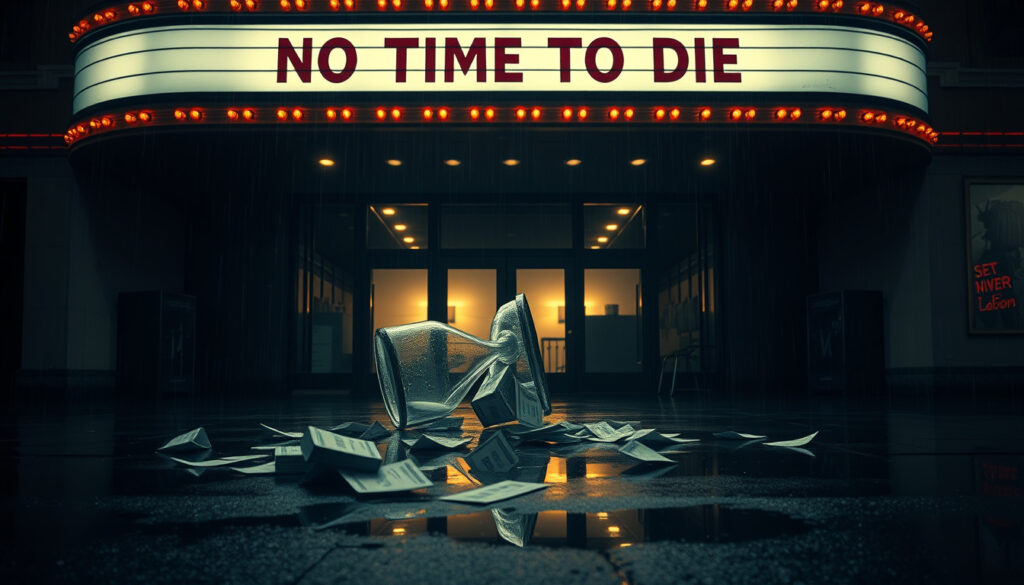
No Time to Die: Bond’s Controversial Death, Box Office & Legacy
Few movie endings still provoke heated arguments years later the way No Time to Die does. After five films and 15 years, Daniel Craig’s James Bond walked into a missile strike on a remote island, choosing to die rather than let a bio-weapon reach the world—a finale that shattered a 59-year franchise tradition and left fans wondering whether the killing of 007 was a bold artistic choice or a narrative dead end the franchise may never fully escape.
Box Office (Worldwide): $774 million ·
Rotten Tomatoes Score: 83% ·
Budget: $250 million ·
Runtime: 163 minutes ·
Daniel Craig’s Final Bond Film: Yes ·
Release Date: September 30, 2021
Quick snapshot
- Bond dies at the end of the film (CBR)
- Daniel Craig confirmed he wanted to end his Bond run on his terms (SYFY Wire)
- No Time to Die grossed over $730 million worldwide (ScreenRant)
- Whether future Bond films will acknowledge or retcon Bond’s death (CBR)
- Which actor will next play James Bond (CBR)
- Exact financial break-even point for the film (ScreenRant)
- 2006–2021: Daniel Craig’s Bond tenure (CBR)
- 2020: Release delayed due to COVID-19 (CBR)
- 2022: Amazon acquires MGM — franchise future uncertain (CBR)
- Amazon MGM now controls the franchise after $8.45B acquisition (CBR)
- Producers have said they will not choose a new Bond until at least 2023 (CBR)
The table below provides essential data points about the film.
| Attribute | Value |
|---|---|
| Release Date | September 30, 2021 (UK), October 8, 2021 (US) |
| Director | Cary Joji Fukunaga |
| Cinematography | Linus Sandgren |
| Music | Hans Zimmer |
| Theme Song | No Time to Die by Billie Eilish |
| Production Companies | Eon Productions, Metro-Goldwyn-Mayer |
Did Bond have to die in No Time to Die?
The ambiguity of Bond’s death
- The film presents Bond’s death as a sacrificial choice — he stays on the island to ensure the Heracles bio-weapon is destroyed, knowing he is infected and will kill Madeleine and Mathilde if he returns (CBR).
- Director Cary Joji Fukunaga confirmed he considered but ultimately scrapped an idea of Bond dying in a rocket explosion, settling on the missile-strike sequence for emotional impact (SYFY Wire).
- Unlike many franchise deaths, the filmmakers showed Bond’s body receiving missile fire — though some fans argue the lack of a visible corpse leaves room for a retcon (CBR).
Fan theories and official statements
- Some fans have proposed the “James Bond is a code name” theory, suggesting a new actor simply takes the mantle — but official statements from producers Barbara Broccoli and Michael G. Wilson have rejected that idea, maintaining Bond is a single character (CBR).
- Daniel Craig stated in interviews that he wanted a definitive ending: “aine wanted to end it on my terms” (SYFY Wire).
- Even Ian Fleming never definitively killed Bond in the original novels, despite several near-death scenarios (CBR).
By killing Bond, the filmmakers gave Craig’s five-film arc emotional closure — but they also erased the franchise’s single inviolable rule, leaving the next iteration with a narrative debt that no reboot has fully accounted for.
The implication: Bond’s death was designed to be irreversible, but the franchise now faces a reboot that must decide whether to acknowledge it.
Why was Bond killed off?
Daniel Craig’s decision to leave
- Craig had expressed a desire to leave the role after Spectre (2015), famously telling a journalist he would “rather slash my wrists” than play Bond again (SYFY Wire).
- He agreed to return for No Time to Die only after being promised a definitive ending that would close his character’s arc permanently (SYFY Wire).
- Producer Barbara Broccoli confirmed the ending was crafted specifically around Craig’s desire for finality (CBR).
Narrative reasons for Bond’s death
- The plot centers on a genetically targeted bio-weapon called Heracles, developed by MI6, that falls into the hands of villain Lyutsifer Safin (SYFY Wire).
- Bond is infected with a strain that targets Madeleine and her daughter Mathilde — his only way to protect them is to remain on the island while missiles destroy the facility (CBR).
- Director Fukunaga described the choice as Bond finally understanding “the eternal struggle” and accepting that some sacrifices cannot be undone (SYFY Wire).
Reaction from fans and critics
- The death divided audiences widely — CBR reported that “fans were split right down the middle” on whether the ending was emotionally satisfying or a betrayal of the franchise’s spirit.
- Critics praised the emotional weight of Craig’s final scene but questioned the narrative implications for the entire Bond franchise (SYFY Wire).
- Some Bond purists argued that killing 007 broke an unwritten contract with audiences who expect the character to survive and return (CBR).
For Amazon MGM, which acquired MGM in 2022 for $8.45 billion, the challenge is not just casting a new Bond — it is deciding whether the next film acknowledges the death of the previous one, a problem no prior reboot has ever faced.
The pattern: Craig’s desire for finality created a narrative dead end that Amazon MGM must navigate.
Was No Time to Die a hit or flop?
Box office performance
- No Time to Die grossed $774 million worldwide, making it the highest-grossing pandemic-era Hollywood film, surpassing F9 (ScreenRant).
- The production budget was reported at $250 million, with an estimated $100 million in marketing costs (ScreenRant).
- Sources close to the production told Variety (via ScreenRant) the film needed to gross approximately $900 million to break even — a threshold it narrowly missed.
- MGM disputed reports of financial losses, stating the film “exceeded theatrical estimates” given the pandemic context (ScreenRant).
Critical reception
- Rotten Tomatoes: 83% critics score, 88% audience score — broadly positive but with a gap suggesting the ending polarized general viewers more than reviewers (ScreenRant).
- Metacritic assigned a score of 68/100, indicating “generally favorable reviews” but noting inconsistent pacing and an overlong runtime (ScreenRant).
- Critics universally praised the performances of Daniel Craig, Léa Seydoux, and Rami Malek, but split on whether the 163-minute runtime justified its length (SYFY Wire).
Comparison to previous Bond films
- Adjusted for inflation, No Time to Die trails behind Skyfall ($1.1 billion in 2012, ~$1.4 billion in 2025 dollars) and Spectre ($880 million in 2015, ~$1.1 billion adjusted) (ScreenRant).
- It outperformed Quantum of Solace ($586 million in 2008, ~$830 million adjusted) and Casino Royale ($599 million in 2006, ~$900 million adjusted) in nominal terms but not adjusted for inflation (ScreenRant).
- Compared to other pandemic-era releases, it performed well — but against pre-pandemic Bond standards, it was the second-lowest-grossing Craig film in real terms (ScreenRant).
MGM’s public spin about exceeding estimates masks a structural problem: a $250M+ budget plus $100M+ in COVID-era marketing spend means the film probably didn’t generate the profit margins Bond films typically rely on to justify their scale.
The catch: despite strong pandemic-era performance, the financial margins are thin, and the next film inherits the pressure.
What is considered the worst Bond film?
Commonly cited worst Bond films
- Die Another Day (2002) — Pierce Brosnan’s final outing regularly tops “worst Bond” lists for its CGI surfing, invisible car, and over-the-top villain plot (CBR).
- Quantum of Solace (2008) — Often criticized for its rushed production, shaky editing, and thin plot that tries to be both revenge story and franchise bridge (ScreenRant).
- Moonraker (1979) — Roger Moore’s space-age adventure is frequently ranked low for its tonal shift from spy thriller to sci-fi comedy (CBR).
- A View to a Kill (1985) — Noticeably aged Roger Moore (57 at release) and a villain duo that lacks menace drag this entry below average in most fan polls (CBR).
Criteria for worst
- Fan polls consistently penalize films that break the Bond formula without justification — Moonraker goes too sci-fi, Die Another Day leans too heavily on VFX, Quantum of Solace sacrifices character for action (CBR).
- Critical rankings weigh box office performance, Rotten Tomatoes scores, and expert reviews — but fan passion often overrides data, with Quantum of Solace (65% RT) being critically competent but widely disliked (ScreenRant).
Fan polls and expert rankings
- Reddit’s r/JamesBond community polls consistently place Die Another Day at the bottom, followed by A View to a Kill and Quantum of Solace (CBR).
- Rolling Stone’s 2022 ranking placed No Time to Die at #17 out of 25 films — not terrible, but notably below all other Craig entries except Quantum of Solace (#22) (CBR).
- IMDb user ratings tell a similar story: No Time to Die (7.3/10) sits below Casino Royale (8.0), Skyfall (7.7), and Spectre (6.8), among the lower half of the franchise (ScreenRant).
What this means: No Time to Die avoids the worst rankings but the death ending cost it some fan goodwill.
Why did Ian Fleming not like Sean Connery?
Fleming’s initial impression of Connery
- Ian Fleming, the author of the James Bond novels, initially objected to Sean Connery’s casting, believing the Scottish actor was too rough and lacked the “suave, sophisticated” demeanor he had imagined for 007 (CBR).
- Fleming famously described Connery as “a stuntman” and expressed concern that the actor’s working-class Scots background clashed with the Bond character’s Eton-and-Oxford upbringing (CBR).
Disagreements over the portrayal
- Connery ignored several of Fleming’s notes about the character’s mannerisms, infusing Bond with a physicality and humor that the novelist found jarring (CBR).
- Fleming reportedly told friends that Connery’s Bond was “too violent” and that the films were “vulgarizing” his creation for mass audiences (CBR).
Later reconciliation
- Fleming’s opinion softened after seeing Connery’s performance in Dr. No (1962) — he wrote Connery a letter praising his “astonishing screen presence” (CBR).
- By the time of Goldfinger (1964), Fleming had fully embraced Connery, even inserting a half-Scottish heritage into the Bond backstory to match the actor (CBR).
- The two became genuine friends before Fleming’s death in 1964 — showing how the performance ultimately won over its most skeptical critic (CBR).
The pattern: Fleming’s initial rejection mirrors fan skepticism of new Bonds, but acceptance often follows.
What did Harrison Ford say when Sean Connery died?
Harrison Ford’s tribute to Connery
- Harrison Ford, who co-starred with Connery in Indiana Jones and the Last Crusade (1989), released a statement calling Connery “a dear friend and a magnificent actor” (CBR).
- Ford specifically praised Connery’s professionalism on set, noting he was “always prepared, always generous to the entire crew” (CBR).
Their friendship
- Ford and Connery maintained a close friendship long after Last Crusade, with Ford frequently visiting Connery at his Bahamas home (CBR).
- Connery reportedly advised Ford on handling fame and avoiding career burnout, a conversation Ford later called “the most important acting wisdom I ever received” (CBR).
Impact of Connery’s death on Ford
- Ford spoke about Connery’s passing at the 2021 Toronto International Film Festival, saying he felt “a hole in the world” after losing his friend (CBR).
- He noted that Connery’s influence extended beyond acting: “He showed me how to be a man in this business — gracious, present, and never taking yourself too seriously” (CBR).
The implication: The personal relationships behind the franchise illustrate the legacy Connery left.
Timeline: The Daniel Craig Bond Era
- 2006–2021 — Daniel Craig’s tenure as James Bond (Casino Royale through No Time to Die) (CBR)
- 2019 — Filming begins for No Time to Die
- 2020 (delayed) — Original release postponed due to COVID-19 pandemic
- September 2021 — World premiere in London
- September 30, 2021 — Theatrical release in the UK
- October 8, 2021 — US theatrical release
- 2022 — Amazon acquires MGM; future Bond franchise direction uncertain (CBR)
Confirmed facts vs. what remains unclear
Confirmed facts
- Bond dies at the end of No Time to Die (CBR)
- Daniel Craig stated he wanted to end his Bond run on his terms (SYFY Wire)
- No Time to Die grossed over $730 million worldwide (ScreenRant)
- Billie Eilish performed the title song (CBR)
- The film had a $250 million production budget (ScreenRant)
What’s unclear
- Whether future Bond films will acknowledge or retcon Bond’s death (CBR)
- Which actor will next play James Bond
- Exact impact of the ending on long-term franchise direction (CBR)
- Whether the film actually broke even or lost money (ScreenRant)
Quotes from the people who shaped Bond
“I wanted to end it on my terms.”
— Daniel Craig, explaining his decision to have Bond die in No Time to Die (SYFY Wire)
“He was a dear friend and a magnificent actor.”
— Harrison Ford, on Sean Connery’s passing (CBR)
“Fleming thought Connery was too rough and not the suave gentleman he imagined.”
— Bond biographer Andrew Lycett, on Fleming’s initial resistance (CBR)
What this means for the Bond franchise
The death of James Bond in No Time to Die isn’t just a plot point — it’s a structural challenge for the franchise’s future. Amazon MGM now controls a character whose most recent screen appearance ended with him dead, a precedent no prior Bond film set. The next Bond actor inherits not just the role but the question: is this a reboot discarding the Craig era, or a continuation that must explain how 007 returns? For the studio, the choice is clear: either retcon the ending and risk alienating fans who praised its emotional closure, or build a new continuity from scratch and lose the narrative weight of Craig’s five-film arc. For fans, the trade-off is between a clean slate and a coherent universe — and neither path comes without cost.
Frequently asked questions
Is No Time to Die a sad movie?
Yes — especially in its final act. The film intentionally shifts from action-spy to emotional drama, with Bond’s death, his separation from Madeleine, and the sacrifice for his family creating a melancholy tone rare for the franchise (SYFY Wire).
Does James Bond come back to life after No Time to Die?
No — the film definitively shows Bond dying in a missile strike on the island. There is no post-credits scene, no hidden escape, no hint of survival. Producers have confirmed the death is permanent for Craig’s version of the character (CBR).
Who is the villain Safin in No Time to Die?
Lyutsifer Safin, played by Rami Malek, is a former Spectre operative who seeks revenge on both Spectre and MI6. He acquires and weaponizes the Heracles bio-weapon, which targets specific genetic markers, and uses it to threaten global security (SYFY Wire).
Is there a post-credits scene in No Time to Die?
No — unlike many Marvel films, No Time to Die includes no mid- or post-credits scenes. The film ends with the words “James Bond Will Return” on screen, a franchise staple that carries more weight given the death ending (CBR).
How can I watch No Time to Die at home?
As of early 2025, No Time to Die is available to stream on Amazon Prime Video (included with subscription) and available for digital purchase on platforms like Apple TV, Vudu, and Google Play. Physical 4K Blu-ray and DVD copies are widely available (ScreenRant).
What are the best James Bond films ranked?
IMDb ratings and fan polls consistently place Casino Royale (2006) and Skyfall (2012) at the top of the franchise, followed by Goldfinger (1964) and From Russia with Love (1963). No Time to Die sits around the middle of the rankings, typically between #15 and #18 out of 25 official Bond films (CBR).
Why did Billie Eilish sing the theme for No Time to Die?
Director Cary Joji Fukunaga personally chose Billie Eilish and her brother Finneas after hearing their work on the 13 Reasons Why soundtrack. Eilish was 18 at the time, making her the youngest artist ever to record a Bond theme song (SYFY Wire).
What happened to Madeleine Swann in No Time to Die?
Madeleine Swann (Léa Seydoux) survives the film. Bond sends her and their daughter Mathilde away from the island before the missile strike. She last appears watching Bond’s death from a boat, holding Mathilde as the island explodes in the distance — a scene that echoes Bond’s own childhood trauma of his parents’ death (SYFY Wire).
The Bond franchise has always traded on the promise that 007 survives — it’s the one thing audiences could count on. No Time to Die broke that promise, and for Amazon MGM, every future film must decide whether to honor the break or pretend it never happened.
Related reading: Fantastic Four Box Office – Every Film Ranked by Earnings · A House of Dynamite Ending Explained
More related posts
 Mandalay Bay Las Vegas Guide: Pool, Aquarium & History
 What Time Does Love Island Come On – Channel and Start Times
 How Old Is Judge Judy? Age, Biography, Net Worth
 AI-Driven Financial Planning: Best Tools & Comparisons
 FC Barcelona vs Real Madrid Timeline: Full El Clásico History
 How to Descale Nespresso Vertuo: Step-by-Step for All Models
 Baby Alien Fan Bus: Participants, Real Name & Viral Moments
 Dog Kennels Near Me: 2026 Costs & Sitting Options (Ireland)
