Open Checking Account Online – Step-by-Step 2024 Guide
Digital banking has fundamentally reshaped how Americans access financial services, with online checking account applications now processing in as little as five minutes. Most major financial institutions and digital-first banks offer fully remote enrollment, eliminating the need for physical branch visits while maintaining federal deposit protections up to $250,000 per depositor.
The shift toward paperless verification accelerated significantly in 2024, driven by improved mobile identity scanning and real-time database authentication. However, applicants still face strict documentation requirements regarding residency status and tax identification, with significant variations in eligibility for non-citizens and those without Social Security numbers.
Understanding the specific prerequisites, fee structures, and timeline expectations helps distinguish between marketing promises and actual account functionality. This analysis examines current enrollment protocols across major institutions to provide verified benchmarks for prospective account holders.
How Do I Open a Checking Account Online?
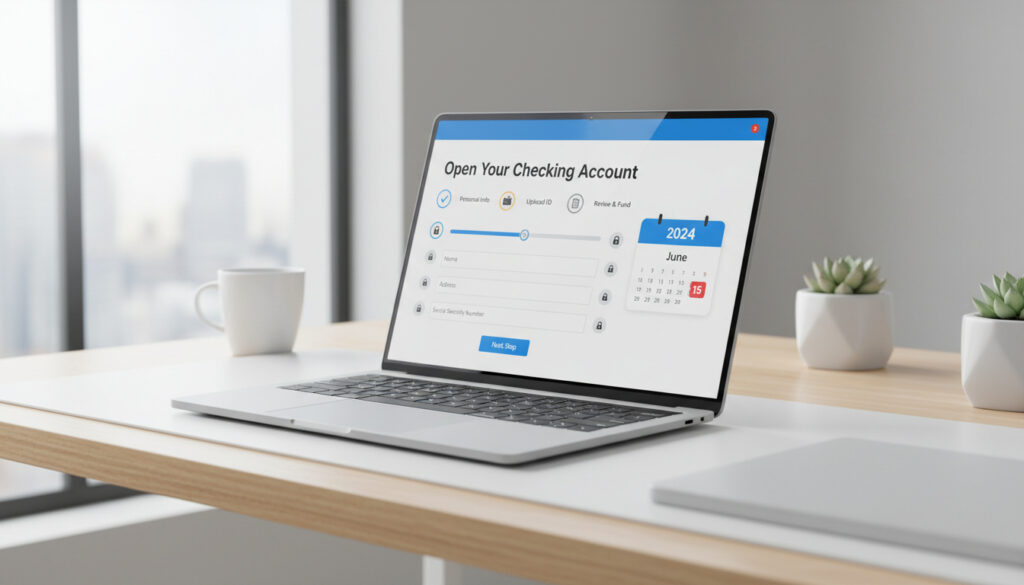
The digital application process requires five distinct stages: selecting an account type, gathering verification documents, submitting personal data, funding the initial balance, and activating digital access tools. According to NerdWallet, most consumers complete the interactive portions within ten minutes, though backend verification may extend the total timeline.
Time Investment
5–15 minutes for standard applications; instant approval available for U.S. citizens with clean verification records
Core Requirements
Government-issued photo ID, valid SSN or ITIN, and physical U.S. residential address (P.O. boxes rejected)
Initial Costs
Zero-dollar opening deposits increasingly standard; monthly maintenance fees often waivable with direct deposit
Access Speed
Immediate digital banking access upon approval; physical debit cards arrive via mail within 5–10 business days
Critical Factors for Success
- No branch visit required for applicants possessing standard U.S.-issued documentation
- FDIC insurance protection applies automatically to eligible deposits
- Mobile check deposit and digital wallet integration activate within 24 hours of approval
- Non-residents without SSN face significant restrictions and potential automatic denial
- Overdraft protection services require separate manual enrollment post-approval
- Paper statement opt-ins frequently trigger $5–$12 monthly service charges
- Joint account applications require both parties to complete separate identity verifications simultaneously
Enrollment Requirements at a Glance
| Requirement | Specification | Acceptable Forms |
|---|---|---|
| Legal Name | Exact match with government ID | Driver’s license, passport, state ID |
| Residential Address | Physical U.S. location required | Utility bill, lease agreement, bank statement |
| Tax Identification | SSN or ITIN mandatory | Social Security card, IRS documentation |
| Age Minimum | 18 years (minor accounts vary) | Birth certificate for youth accounts |
| Opening Deposit | Frequently $0 online | External bank transfer, debit card |
| Credit Verification | Soft inquiry or ChexSystems scan | No hard credit pull reported |
| Contact Methods | Active phone and email required | SMS-capable mobile device |
| Citizenship Status | U.S. residency typically required | Visa documentation for specific accounts |
What Do I Need to Open a Checking Account Online?
Applicants must prepare digital copies of primary identification and proof of address before initiating the secure application portal. Huntington Bank emphasizes that automated verification systems scan document edges and security features, meaning poor image quality triggers manual review delays lasting several business days.
Documentation Standards
Banks require unexpired government-issued photo identification showing the applicant’s current legal name. Acceptable documents include state driver’s licenses, U.S. passports, and military IDs. Secondary address verification typically involves utility statements, rental agreements, or official government correspondence dated within the previous sixty days. All documents must display the applicant’s name and physical residential address; commercial mail forwarding services often fail verification algorithms.
Photograph identification documents against a dark, solid background with natural lighting. Ensure all four corners remain visible and no flash reflections obscure holographic security features. Blurry uploads trigger manual review protocols that extend approval timelines from minutes to several days.
Tax Identification Requirements
A valid Social Security number remains the standard identifier for online applications, though Individual Taxpayer Identification Numbers (ITIN) satisfy requirements at select institutions for non-citizens legally working in the United States. Chase and several regional banks explicitly state that applications submitted without either identifier face automatic rejection through digital channels, requiring instead in-person branch visits with alternative documentation.
Is It Free to Open a Checking Account Online?
The majority of national banks eliminated opening deposit requirements for online checking products in 2024, though fee structures vary significantly based on account activity and statement delivery preferences. Capital One offers zero-fee checking with no minimum balance, while traditional institutions like Chase impose waivable monthly charges depending on direct deposit activity.
Fee Structures and Minimum Deposits
Truly free checking accounts carry no monthly maintenance fees, no minimum balance requirements, and no opening deposits. ATM fee rebates vary by institution. Overdraft protection services, while optional, often incur $10–$35 per transaction when activated. Electronic statement enrollment typically serves as the gateway to fee waivers; selecting paper statements automatically triggers monthly service charges at most institutions.
Non-Citizen Eligibility Barriers
Non-U.S. residents without Social Security numbers encounter substantial obstacles when attempting fully digital enrollment. Most automated verification systems cannot validate foreign identification documents or international addresses. While ITIN holders qualify at select digital banks, applicants without U.S. tax identification generally must visit physical branches with passports and visa documentation to establish banking relationships.
What Are the Best Banks for Opening a Checking Account Online?
Evaluation criteria prioritize fee transparency, mobile application functionality, and federal insurance backing. Discover offers cashback rewards on debit purchases, while Capital One provides nationwide ATM access without surcharges. Chase maintains hybrid flexibility allowing online opening with subsequent branch servicing.
All recommended institutions maintain FDIC insurance coverage up to $250,000 per depositor, per account ownership category. This protection applies automatically upon account approval with no additional enrollment required or maintenance fees charged.
Banks increasingly utilize third-party address verification services that flag virtual mailbox services, commercial forwarding addresses, and recent address changes. Applicants using these services may trigger additional scrutiny or account freezes regardless of citizenship status or credit history.
| Institution | Key Features | Monthly Fee | Minimum Deposit |
|---|---|---|---|
| Capital One 360 Checking | No overdraft fees, mobile check deposit, 70,000+ ATMs | $0 | $0 |
| Discover Cashback Debit | 1% cashback on $3,000 monthly purchases, no fees | $0 | $0 |
| Chase Total Checking | Branch access, extensive ATM network, Zelle integration | $12 (waivable) | $0 |
| Huntington Asterisk-Free | No overdraft fees, 24-hour grace period, instant debit card | $0 | $0 online |
How Long Does It Take to Open a Checking Account Online?
The complete process spans from initial application to full functionality across five distinct phases. According to Bankrate, while the digital form completion requires minimal time, backend verification protocols introduce variability based on identity confirmation complexity.
- Account Selection: Comparing fee schedules and feature sets requires 5–10 minutes of review across institutional websites.
- Application Submission: Entering personal data, uploading identification, and acknowledging terms typically consumes 5–15 minutes.
- Identity Verification: Automated systems process standard applications instantly; edge cases requiring manual review extend 1–3 business days.
- Initial Funding: Electronic transfers from external accounts settle within 1–3 business days; mobile check deposits may hold funds 24–48 hours.
- Card Activation: Digital wallets activate immediately upon approval; physical debit cards arrive via mail within 5–10 business days.
What Restrictions Apply to Non-US Residents and Credit Checks?
Regulatory requirements create clear distinctions between established eligibility criteria and institution-specific variables that remain opaque until application submission.
| Established Standards | Variable Considerations |
|---|---|
| U.S. citizens with valid SSN qualify for instant online approval at all major banks | Specific visa categories accepted vary by institution and remain undisclosed in marketing materials |
| ITIN holders qualify at select digital-first banks and credit unions | Approval rates for recent immigrants with limited U.S. credit history fluctuate seasonally |
| Physical U.S. residential address mandatory for all FDIC-insured institutions | Exact address verification algorithms and tolerance for recent moves differ between banks |
| ChexSystems reports review past banking behavior rather than credit scores | Negative reporting thresholds that trigger automatic denial vary and are not publicly disclosed |
| Applicants over 18 may open individual accounts; minor accounts require adult co-owners | State-specific regulations regarding emancipated minors and account ownership create jurisdictional ambiguity |
Why Did Online Checking Become Standard in 2024?
The universal adoption of smartphone-based identity verification transformed checking account enrollment from a branch-dependent process to a fully remote capability. Regulatory guidance from the Office of the Comptroller of the Currency clarified digital identity standards, allowing banks to accept encrypted mobile uploads of driver’s licenses and passports rather than requiring physical document inspection.
Concurrent improvements in real-time database connectivity enable instantaneous verification of Social Security numbers against Treasury Department records, eliminating the waiting periods previously required for manual background reviews. These technical shifts coincided with consumer demand for contactless services following previous years’ operational disruptions.
Financial institutions now compete heavily on mobile user experience, recognizing that retail service expectations increasingly influence banking preferences. The result is a marketplace where digital account opening serves as the baseline rather than a premium feature.
What Do Banking Regulators Say About Digital Account Opening?
Federal oversight agencies emphasize that online account opening must maintain equivalent security standards to in-person enrollment while expanding financial access. The Consumer Financial Protection Bureau mandates that banks provide clear fee disclosures before account finalization, regardless of the application channel.
The Federal Deposit Insurance Corporation consistently reminds consumers that digital banks carry identical protections to brick-and-mortar institutions, provided the institution displays FDIC membership. Regulatory guidance specifically prohibits discrimination based on the application method, ensuring online applicants receive the same account terms available through branch networks.
Preparing for Your Online Application
Successful online account opening requires advance preparation of high-quality identification photographs, verification of your current mailing address against official records, and selection of an institution whose fee structure aligns with your transaction patterns. Those seeking localized service options should verify that digital-only banks meet their cash deposit and customer service needs before committing to the application process.
Frequently Asked Questions
Can I open a checking account online if I have bad credit?
Yes. Most banks verify identity through ChexSystems, which tracks banking history rather than credit scores. Negative marks may trigger denial, but standard credit reports rarely factor into checking account approvals.
What is the minimum age requirement for opening a checking account online?
Applicants must be 18 years old to open individual accounts online. Minor accounts require adult co-owners and typically cannot be established through fully digital channels due to signature verification requirements.
Can two people open a joint checking account together online?
Yes, though both parties must complete separate identity verifications simultaneously. Most banks require both applicants to provide documentation and electronically sign agreements during the same application session.
How can I deposit cash into an account opened online?
Options include purchasing money orders for mobile deposit, utilizing in-network ATMs that accept cash, or visiting partner retail locations that offer deposit services. Purely online banks typically lack physical branches for cash handling.
Is it possible to open a business checking account using the same process?
No. Business accounts require additional documentation including Employer Identification Numbers, articles of incorporation, and operating agreements. These complex verification requirements necessitate specialized application processes distinct from personal checking.
What should I do if my online application is declined?
Request the specific reason from the bank, verify your ChexSystems report for errors, and consider visiting a physical branch with alternative documentation. Some banks allow manual review overturning automated denials.
More related posts
 What Do You Meme: Rules, How to Play, and Age Guide
 What Do Bedbug Bite Look Like? Identification Guide
 John Bell (Scottish Actor): Biography, Age & Career
 Resident Evil Requiem Review: Scary, Long, Worth It?
 What Are Prime Numbers? Definition, List & Easy Tricks
 iPhone Repair Near Me in Ireland: Costs and Best Shops
 Where to Watch Denver Broncos vs Buffalo Bills: TV & Stream
 Cast of Leanne (TV Series): Full List of Actors and Characters
