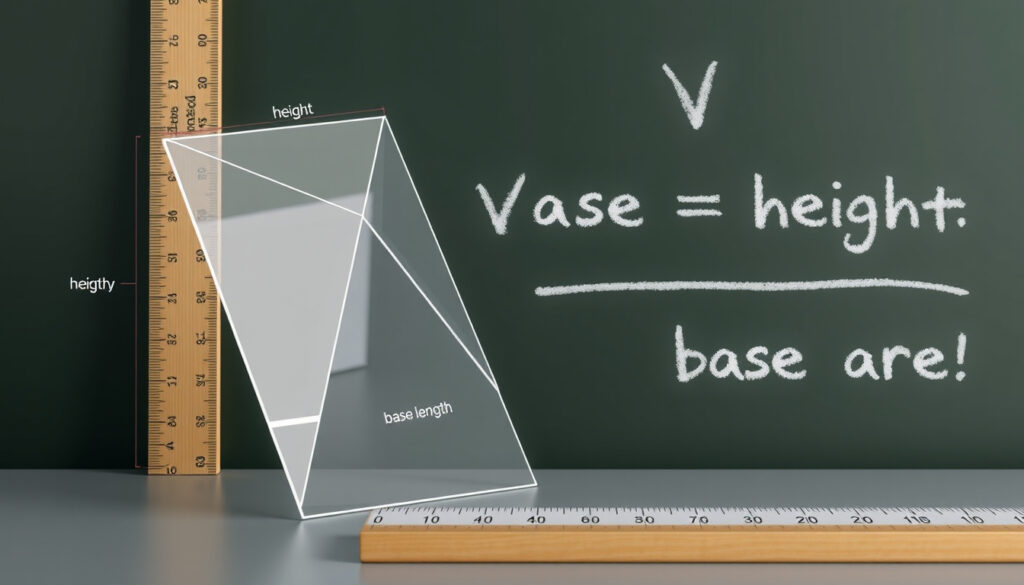
Volume of a Triangular Prism: Formula, Steps & Examples
If you’ve ever mixed up the formulas for a triangular prism and a triangular pyramid, you’re not alone. The two shapes look similar, but their volume formulas differ by a critical factor of 1/3.
Standard Formula: V = Area of triangular base × length of prism ·
Simplified Notation: V = ½ × b × h × l ·
Units: cubic units (e.g., cm³, m³, in³)
Quick snapshot
- V = ½ × b × h × l (Cuemath (math education site))
- V = (area of triangle) × length (Third Space Learning (GCSE math resource))
- 1. Measure base and height of the triangular face (Study.com (instructional resource))
- 2. Compute triangle area: ½ × base × height (Study.com (instructional resource))
- 3. Multiply triangle area by prism length (Study.com (instructional resource))
- Prism: V = base area × height (no 1/3 factor) (Khan Academy (nonprofit math education))
- Pyramid: V = 1/3 × base area × height (Khan Academy (nonprofit math education))
- Base triangle: b=6 cm, h=4 cm → area=12 cm² (Omni Calculator (math tools site))
- Prism length=10 cm → V=120 cm³ (Omni Calculator (math tools site))
These five key properties define the structure of any triangular prism, whether it’s right or oblique:
| Property | Value |
|---|---|
| Number of faces | 5 |
| Number of vertices | 6 |
| Number of edges | 9 |
| Shape of bases | Triangles |
| Shape of lateral faces | Rectangles |
What is the formula for volume for a triangular prism?
What is the basic prism volume formula?
The formula for the volume of any prism is the same: area of the base times the height (or length) of the prism. For a triangular prism, the base is a triangle.
- General rule: V = B × h, where B = area of the triangular base and h = prism height (Third Space Learning (GCSE math resource)).
- Common classroom form: V = ½ × b × htriangle × l, using the triangle’s base and height, then multiplying by prism length (Cuemath (math education site)).
The ½ comes from the triangle area formula (½ × base × height). A triangle covers half the area of a rectangle with the same base and height — so the volume of a triangular prism is half that of the corresponding rectangular prism with the same base dimensions and length. That’s the geometric intuition behind the ½.
For a right triangular prism where the triangular face is a right triangle, this relationship becomes even clearer: the prism’s volume is exactly half the volume of a rectangular prism with the same base and length. That link is often used in seventh-grade math curricula (YouTube (instructional video)).
The implication: The formula works for any triangular base — right, equilateral, isosceles, or scalene — as long as you correctly compute the triangle’s area. The ½ factor never changes because every triangle is half of a parallelogram.
How do you calculate the surface area of a triangular prism?
What is the formula for the area of a triangular prism?
Surface area combines the areas of all five faces: two triangular bases and three rectangular lateral faces.
- Formula: SA = 2 × (area of triangular base) + (perimeter of triangle) × prism length
- Each rectangular face has dimensions: one side equals a triangle side, the other equals the prism length.
A worked example from Third Space Learning shows: for a triangle with sides 5, 6, 7 cm and prism length 10 cm, the lateral surface area is (5+6+7) × 10 = 180 cm², plus the two triangles.
What this means: While volume uses cubic units (three dimensions), surface area uses square units. Mistaking the two is a common error on tests, so always check whether the question asks for volume or surface area.
Why is there a 1/3 in the volume formula for a pyramid?
What is the volume of a 3 sided pyramid?
A triangular pyramid (also called a tetrahedron when all faces are equilateral) has a different volume formula: V = ⅓ × base area × height.
The ⅓ factor arises from integral calculus: a pyramid is essentially a prism that tapers to a point. If you stack the cross-sectional areas from apex to base, the average cross-section is one-third of the base area (Khan Academy (nonprofit math education)). A famous demonstration shows that three congruent tetrahedra can fill a triangular prism of the same base and height — confirming the ⅓ factor geometrically.
Students often assume a pyramid’s volume is half that of a prism because it looks like a “pointed prism.” In reality, the factor is ⅓, not ½. The difference stems from linear tapering versus constant cross-section.
The pattern: Prisms (constant cross-section) multiply base area by height. Pyramids (points) add the ⅓ factor. This one-third rule applies to all pyramids, regardless of base shape.
What is the difference between a triangular prism and a triangular pyramid?
Why do prisms and pyramids have different volume formulas?
The two shapes look alike at first glance but differ in how their volume formulas work:
| Aspect | Triangular Prism | Triangular Pyramid |
|---|---|---|
| Bases | Two congruent triangular bases | One triangular base; apex at one point |
| Volume formula | V = base area × height | V = ⅓ × base area × height |
| Factor added | No factor (already ½ from triangle area) | ⅓ factor on top of triangle area |
| Example (b=6, h=4, length=10) | Volume = 120 cm³ | Volume = 40 cm³ (same base, same height) |
The trade-off: the prism’s volume is always three times that of a pyramid with the same base triangle and height. That’s why understanding which shape you’re dealing with is essential before plugging numbers into a calculator.
What units are used for volume of a triangular prism?
How to convert units for volume calculations?
Volume measures three-dimensional space, so the units are always cubic: cubic centimeters (cm³), cubic meters (m³), cubic inches (in³), etc. When dimensions are given in mixed units, the first step is to convert everything to the same unit (CalculatorSoup (geometry solver)).
- Common conversions: 1 m³ = 1,000,000 cm³; 1 liter = 1,000 cm³.
- If base dimensions are in inches and prism length in feet, convert all to inches before applying V = ½bhl, then convert the final volume to cubic feet if needed.
A typical mistake: using base triangle height of 4 inches and prism length of 2 feet without converting. The correct procedure: convert 2 feet to 24 inches, then compute: ½ × 6 × 4 × 24 = 288 in³, which equals 0.167 ft³. Omni Calculator provides unit-switching functionality to avoid such errors.
Why this matters: Classroom problems and real-world construction projects both demand unit consistency. One wrong conversion — say, mixing inches with centimeters — can throw a volume calculation off by a factor of 16.4 (since 1 in³ = 16.387 cm³).
Step-by-step: How to find the volume of a triangular prism
- Identify the dimensions of the triangular base. You need the base length of the triangle and its perpendicular height (altitude). If the triangle is not right-angled, drop a perpendicular from the opposite vertex to the base.
- Compute the area of the triangle. Use A = ½ × base × height. For an equilateral triangle, use A = (√3/4) × side² (Cuemath (math education site)).
- Measure the length of the prism — the distance between the two triangular bases. This is sometimes labeled as the prism height.
- Multiply the triangle area by the prism length. V = Atriangle × l.
- Report the answer in cubic units matching the input units (Study.com (instructional resource)).
Example calculation
Work through a typical 7th-grade problem: a triangular prism has a base triangle with base = 8 cm and height = 5 cm. The prism length is 12 cm.
- Triangle area = ½ × 8 × 5 = 20 cm²
- Volume = 20 × 12 = 240 cm³
Compare with a triangular pyramid using the same base and height: V = ⅓ × 20 × 12 = 80 cm³ — exactly one-third of the prism volume (Khan Academy (nonprofit math education)).
Quotes from educators
“The volume of a triangular prism is found by multiplying the area of its triangular base by the prism length.”
— Third Space Learning (GCSE math tutors)
“For a triangular prism, the base is the triangular face, and the volume formula still follows the general prism rule of base area times prism height.”
Both sources reinforce the same core identity: The triangular prism is a prism first and a triangle second. Once you compute the triangular base area, the rest is identical to any other prism.
Related reading: Rate of Change Formula
maisonetmath.com, youtube.com, youtube.com, thirdspacelearning.com
Frequently asked questions
What is the volume of a triangular prism with base 6 cm, height 4 cm, and length 10 cm?
Triangle area = ½ × 6 × 4 = 12 cm². Volume = 12 × 10 = 120 cm³.
How do you find the volume of an oblique triangular prism?
The same formula applies: V = area of the triangular base × the perpendicular height (distance between bases), not the slant height. Use the vertical distance.
What is the volume of a triangular prism in cubic feet if dimensions are in inches?
Convert all dimensions to inches first, compute volume in in³, then divide by 1,728 (12³) to get cubic feet. Example: 288 in³ ÷ 1,728 = 0.167 ft³.
Is the volume of a triangular prism the same as a rectangular prism with identical base area?
If the base areas are equal and the prism lengths are equal, the volumes are identical. The base shape does not matter — only the area and length.
How does the volume formula change for a triangular prism with a scalene base?
No change. Compute the scalene triangle’s area using Heron’s formula or by dropping an altitude, then multiply by prism length. The formula V = base area × length holds for any triangle type.
What is the volume of a triangular prism if the base is an equilateral triangle of side 5 cm and length 12 cm?
Equilateral triangle area = (√3/4) × side² = (√3/4) × 25 ≈ 10.825 cm². Volume ≈ 10.825 × 12 = 129.9 cm³.
For students and professionals working with geometry, the distinction between prism and pyramid volume formulas is one of the most frequently tested concepts. The prism formula — base area times height — is already a half-scale of a rectangular prism because of the triangle’s ½ factor. The pyramid adds another ⅓ because it tapers. In practice, remembering that a prism keeps a constant cross-section while a pyramid shrinks to a point is the quickest way to know which formula to use. For anyone preparing for a math exam or a construction project, the choice is clear: check the shape first, then apply the correct multiplicative factor — or risk being off by a factor of three.
More related posts
 Aldi Ad This Week: Weekly Leaflet & Special Offers Online
 One Piece PUMA Shoes: Character Sneaker Guide
 How to Check Your Credit Score in Ireland for Free
 What Are Prime Numbers? Definition, List & Easy Tricks
 FC Barcelona vs Real Madrid Timeline: Full El Clásico History
 Chicken Thighs in Oven – Complete Time and Temp Guide
 Open Stores Near Me: Find 24-Hour & Holiday Hours in Ireland
 Best Mate de Coca Near Me: Where to Buy in Ireland (2025)
