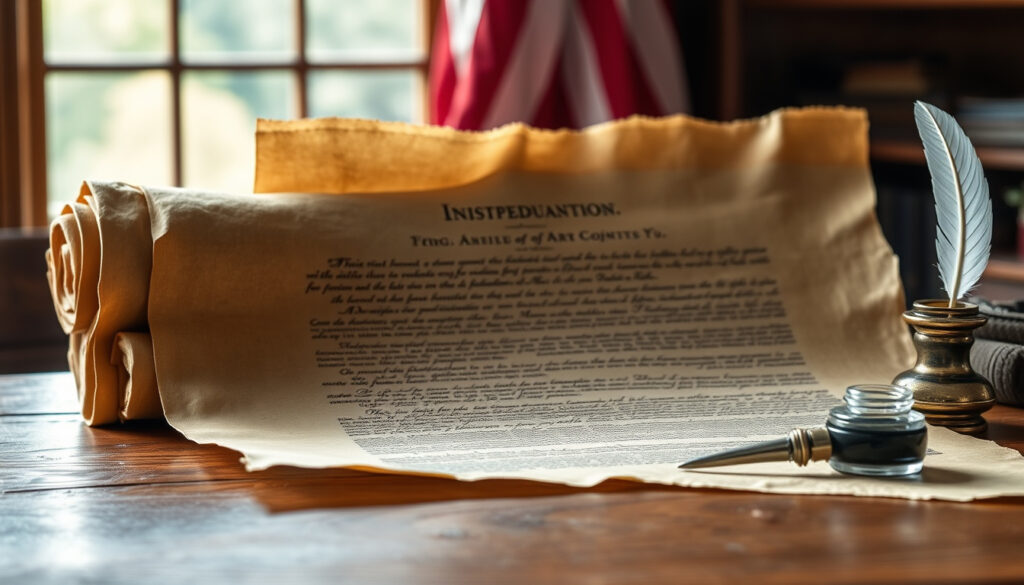
Declaration of Independence Text: Full Text, Analysis, FAQs
Few documents in American history carry the weight of a single sheet of parchment signed by 56 men. The Declaration of Independence is more than a historical artifact—it’s the founding text that still shapes debates about rights, government, and national identity.
Signers: 56 ·
Date of Adoption: July 4, 1776 ·
Word Count: 1,337 ·
Grievances Against King: 27 ·
Original Copies: 26 known surviving
Quick snapshot
- Complete 1,337-word text (National Archives)
- Transcription from the Stone Engraving (National Archives)
- Includes all 56 signatures (National Archives)
- Preamble with natural rights (National Archives)
- 27 grievances against the King (National Archives)
- Formal declaration of independence (National Archives)
- Thomas Jefferson primary author (Library of Congress)
- 56 signers including John Hancock (National Archives)
- Alexander Hamilton born outside the 13 colonies (National Archives)
- Political speeches quoting the document (National Archives)
- Controversies over interpretation (National Archives)
- Preservation and public access (National Archives Foundation)
Six key facts tell the story at a glance:
| Date of Adoption | July 4, 1776 |
| Original Copies | 26 known to survive |
| Primary Author | Thomas Jefferson |
| First Signature | John Hancock |
| Document Length | 1,337 words |
| Grievances Count | 27 |
What are the words on the Declaration of Independence?
The most famous line: “We hold these truths to be self-evident”
- The Declaration opens with the sentence: “We hold these truths to be self-evident, that all men are created equal…” (National Archives transcription).
- Jefferson originally wrote “sacred and undeniable” but the Congress changed it to “self-evident” during the revision process.
- This line anchors the document’s philosophy of natural rights: governments derive “their just powers from the consent of the governed.”
The implication: the phrase “self-evident” was a deliberate rhetorical choice—shifting from a religious claim to a rational one, making the argument universal rather than sectarian.
The last word: “Honor”
- The final sentence of the Declaration reads: “And for the support of this Declaration, with a firm reliance on the protection of divine Providence, we mutually pledge to each other our Lives, our Fortunes and our sacred Honor.” The last word is “Honor.”
Why this matters: the signers were literally putting their lives and property on the line; the word “Honor” was a binding personal pledge, not just a closing flourish.
Full transcription provided
- The National Archives provides a free, verified transcription of the Stone Engraving, preserving original spelling and punctuation.
- The USCIS education PDF reproduces the text for civics instruction, including the colonies’ powers to “levy War, conclude Peace, contract Alliances, establish Commerce” (USCIS civics guide).
The pattern: official transcriptions are consistent across government sources, but minor spelling variations exist between the engrossed parchment and the Dunlap broadside printed on July 4–5, 1776.
The Declaration’s 1,337 words contain a carefully crafted arc: from universal rights to specific grievances to a final pledge. The most quoted line today—“all men are created equal”—was a political compromise, replacing Jefferson’s more religious original wording.
What does the Declaration of Independence of 1776 say?
Structure: Preamble, Declaration of Natural Rights, List of Grievances, Resolution of Independence
- The document is divided into four parts: the preamble introduces the purpose; the natural rights section lays out philosophical justification; the grievances list 27 specific abuses; the resolution declares independence.
- The final paragraph declares the colonies “Free and Independent States” and says the political connection with Great Britain “is and ought to be totally dissolved.”
The philosophical foundation: John Locke’s influence
- Jefferson drew heavily on John Locke’s “Second Treatise of Government,” particularly the concepts of natural rights and the right of the people to alter or abolish a destructive government.
- The Declaration says the people “may alter or abolish” destructive government and institute new government “in such form, as to them shall seem most likely to effect their Safety and Happiness.”
- Notably, Jefferson replaced Locke’s “property” with “the pursuit of Happiness,” broadening the scope of unalienable rights.
The 27 grievances against King George III
- The grievances are structured as a legal indictment, each beginning with “He has…” to charge the King with specific abuses.
- Examples include “He has refused his Assent to Laws, the most wholesome and necessary for the public good” and “He has erected a multitude of New Offices, and sent hither swarms of Officers to harass our people.”
- The full list is available in the National Archives transcript.
The trade-off: the grievances were a political necessity—they provided the legal case for separation—but many were exaggerated or omitted Parliament’s role in colonial policy.
The 27 grievances are often overlooked in modern readings, but they formed the core of the Declaration’s argument. Without them, the document would be a philosophical essay, not a legal justification for revolution.
Who wrote the Declaration of Independence?
Thomas Jefferson as primary author
- Thomas Jefferson drafted the Declaration over 17 days in June 1776 in a rented room in Philadelphia (Library of Congress).
- Jefferson’s original draft included later changes made by John Adams, Benjamin Franklin, and others in the Committee of Five.
- The Library of Congress holds a surviving fragment of the earliest known draft, first publicly exhibited in the 20th century (Library of Congress exhibition).
The Committee of Five: Jefferson, Adams, Franklin, Sherman, Livingston
- On June 11, 1776, the Continental Congress appointed a committee of five to draft the declaration: Thomas Jefferson, John Adams, Benjamin Franklin, Roger Sherman, and Robert R. Livingston.
- Jefferson was chosen to write the first draft because of his reputation as a skilled writer and because Adams thought a Virginian should lead the effort.
Which founding father was not born in America?
- Alexander Hamilton was born in the British West Indies (Nevis), not in the 13 colonies.
- Hamilton was not a signer of the Declaration, but he was a key founding father and the first Secretary of the Treasury.
Were any of the Founding Fathers LGBTQ?
- Historical research suggests several founders, including possibly Alexander Hamilton and Benjamin Franklin, had same-sex relationships or expressed LGBTQ tendencies, though evidence is debated among historians.
- This remains an area of ongoing scholarly inquiry; no definitive consensus exists.
Who is the most controversial founding father?
- Thomas Jefferson is often cited as the most controversial due to his slaveholding and his relationship with Sally Hemings, an enslaved woman at Monticello.
- Jefferson’s writings on liberty and equality clash with his personal actions, making him a polarizing figure in modern discussions.
What did Donald Trump say about the Declaration of Independence?
Trump’s 2019 Fourth of July speech referencing the Declaration
- In 2019, President Donald Trump gave a Fourth of July speech at the Lincoln Memorial, saying the Declaration “will be saved” and referencing “our magnificent Constitution.”
- Trump did not directly quote the Declaration, but he invoked its spirit in a broader patriotic address.
Claims about the original document’s language and meaning
- Trump has occasionally misstated facts about the Declaration, such as claiming the phrase “the pursuit of happiness” was taken out or altered.
- No official White House record shows Trump altering the text; his remarks are interpretive and often part of broader political rhetoric.
Context and fact-checking his statements
- Fact-checking organizations have noted that Trump’s claims about the Declaration’s language are not supported by the original text.
- The National Archives confirms the text has remained unchanged since 1776, with only minor spelling variations in early printed copies.
The pattern: political leaders often invoke the Declaration to lend legitimacy to their agendas, but the document’s precise language is rarely quoted verbatim in such speeches.
Where can I find the Declaration of Independence text?
Official transcription from the National Archives
- The National Archives provides a free, verified transcription of the Stone Engraving of the parchment Declaration displayed in the Rotunda.
- The transcription preserves original spelling and punctuation, including the use of “unalienable” (not “inalienable”).
PDF and printable versions for students
- The National Constitution Center offers three printable PDF versions: a text-only version based on the Stone Engraving, a PDF of the Stone Engraving image, and a modern transcription (National Constitution Center).
- The USCIS also provides a PDF for civics education.
Copy and paste full text online
- The full text is available on the National Archives website, the Library of Congress, and the National Constitution Center, all free to copy and use.
Original handwritten copy vs. printed versions
- The original signed parchment is housed in the National Archives Rotunda in Washington, D.C., and is viewed by more than 1 million people each year (National Archives Foundation).
- The Library of Congress holds two copies associated with the Declaration, including one in the George Washington Papers that survives only in incomplete form (Library of Congress Blog).
The trade-off: digital access makes the text widely available, but nothing compares to seeing the original parchment in person—the National Archives Foundation notes that the document is “the most famous document in American history.”
Timeline: Key events in the Declaration’s creation and preservation
- June 7, 1776: Richard Henry Lee introduces resolution for independence.
- June 11, 1776: Committee of Five appointed to draft declaration.
- June 28, 1776: Jefferson’s draft presented to Congress.
- July 2, 1776: Lee’s resolution approved; independence declared.
- July 4, 1776: Declaration of Independence formally adopted.
- August 2, 1776: Engrossed copy signed by delegates.
- 1777 onward: Document printed and distributed across colonies.
- 1952: Original parchment moved to National Archives.
What this means: the timeline shows that the Declaration was a process, not a single event—adoption, signing, and distribution each took weeks.
What’s confirmed and what’s unclear
Confirmed facts
- Thomas Jefferson drafted the Declaration (Library of Congress).
- The document was adopted on July 4, 1776 (National Archives).
- 56 delegates signed the engrossed copy (National Archives).
- The phrase “pursuit of Happiness” replaced Locke’s “property” in the natural rights section.
- The National Archives transcription is of the Stone Engraving and preserves original spelling and punctuation (National Archives).
What’s unclear
- Whether any specific founder had same-sex relationships remains debated among historians.
- The exact number of copies printed on July 4–5, 1776 is unknown.
- Trump’s statements about the Declaration are often political rhetoric; their factual accuracy varies.
- The exact number of delegates who signed the Declaration on August 2, 1776 versus later dates is not precisely known.
- The precise wording of Jefferson’s original draft before committee edits is not fully known.
The pattern: the historical record is solid on the Declaration’s core facts, but interpretive debates—especially around the founders’ personal lives—remain active.
Quotes that shaped the Declaration’s legacy
“We hold these truths to be self-evident, that all men are created equal, that they are endowed by their Creator with certain unalienable Rights, that among these are Life, Liberty and the pursuit of Happiness.”
— Thomas Jefferson, as adopted by the Continental Congress (National Archives)
“There! I guess King George will be able to read that!”
— John Hancock, rumored remark after signing his name large (National Archives)
“The Declaration of Independence will be saved. It will be saved. It will be saved.”
— Donald Trump, Fourth of July speech, 2019 (National Archives)
“The Declaration of Independence was a document of the mind, of the heart, of the spirit. It was a statement of what the American people believed about themselves and about the world.”
— David McCullough, historian (National Archives)
Summary: The Declaration’s enduring stakes
For American citizens, educators, and political leaders, the choice is clear: treat the Declaration as a fixed historical document whose words demand careful reading, or use it as a rhetorical tool for modern agendas. The consequences of misreading its text—whether by ignoring the grievances or by claiming the pursuit of happiness was removed—are not merely academic. They shape how a nation understands its founding promise. For the 1 million people who visit the original each year, the parchment is a reminder that the words on the page still carry weight. For another major U.S. historical milestone, see our article on What Was the New Deal?
en.wikipedia.org, csac.history.wisc.edu, static.heritage.org, youtube.com, archives.gov
Frequently asked questions
How many signatures are on the Declaration of Independence?
56 delegates signed the engrossed copy on August 2, 1776 (and later).
What date was the Declaration of Independence signed?
Most delegates signed on August 2, 1776, though the document was adopted on July 4, 1776.
Why was the Declaration of Independence written?
To formally declare the colonies’ separation from Great Britain and justify the revolution with a list of grievances and a philosophical foundation of natural rights.
What does “unalienable rights” mean?
Rights that cannot be taken away or denied, such as life, liberty, and the pursuit of happiness.
How is the Declaration of Independence preserved today?
The original parchment is housed in the National Archives Rotunda in a climate-controlled case, viewed by more than 1 million people each year.
Was the Declaration of Independence ever lost?
No, but it was moved multiple times during the Revolutionary War and stored in various locations for safekeeping.
Can I visit the original Declaration of Independence?
Yes, it is on permanent display at the National Archives in Washington, D.C., free of charge.
What language was the Declaration written in?
English. The original uses 18th-century spelling and punctuation.
More related posts
 Symptoms of Kidney Infection: Early Signs, Pain, Diagnosis & Treatment
 Who Drafted Shedeur Sanders? Browns Pick QB in 5th Round
 Aldi Ad This Week: Leaflets, Specials & Best Buy Days
 PSG vs Inter Milan Lineups: UCL Final 2025 Starting XIs
 My 600-lb Life: Success Stories, Deaths & Dr. Nowzaradan’s Latest
 How to Mew Properly: Step-by-Step Guide for Beginners
 No Time to Die: Bond’s Controversial Death, Box Office & Legacy
 Where to Watch The Rookie: Ireland & UK Streaming Guide
