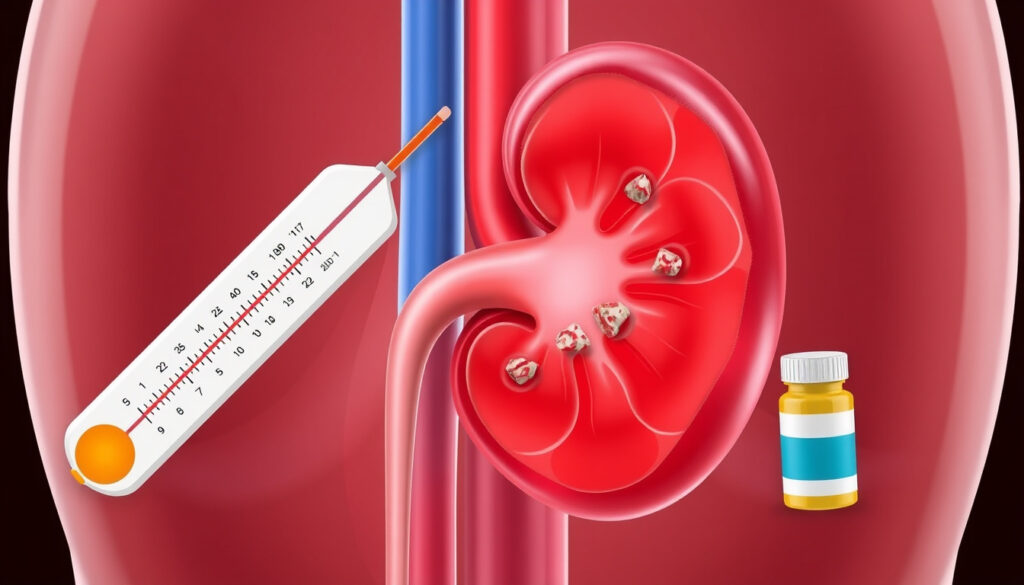
Symptoms of Kidney Infection: Early Signs, Pain, Diagnosis & Treatment
That dull ache in your lower back that won’t quit, paired with a fever that makes you reach for the thermometer — if that sounds familiar, you’re probably wondering whether it’s just a bad UTI or something more serious. Kidney infections, medically known as pyelonephritis, develop when bacteria travel from the bladder up to the kidneys, and they hit differently than a routine urinary tract infection.
Annual incidence in the US: approximately 250,000 cases ·
Gender prevalence: women are 4–5 times more likely than men ·
Common symptom: fever: present in about 90% of cases ·
Common symptom: back pain: reported in 80–90% of patients ·
Hospitalization rate: up to 20% of cases require inpatient care
Quick snapshot
- Fever and chills are hallmark symptoms of a kidney infection (NHS (UK national health authority))
- Antibiotics for 7–14 days are standard treatment (Mayo Clinic (leading US medical center))
- Untreated kidney infection can lead to sepsis (NIDDK (US federal kidney research institute))
- The exact role of cranberry juice in preventing recurrence is still debated (American Academy of Family Physicians (clinical guidance body))
- Optimal duration of antibiotic therapy for uncomplicated cases varies between guidelines (BMJ Best Practice (evidence-based clinical reference))
- Symptoms can develop quickly, over a few hours (Worcestershire Acute Hospitals NHS Trust (UK hospital guidance))
- Antibiotic treatment typically begins working within 48–72 hours (NHS)
- Visit a healthcare provider if you suspect a kidney infection (Healthdirect Australia (government health service))
- Severe cases may require IV antibiotics and hospital admission (NIDDK)
Five key facts about kidney infections, one pattern: the faster you recognize the signs, the less likely you are to land in the emergency room.
The data in the table below shows the core clinical profile of pyelonephritis.
| Label | Value |
|---|---|
| Medical term | Pyelonephritis |
| Common causes | Escherichia coli bacteria (90% of cases) |
| Typical treatment duration | 7–14 days of antibiotics |
| Complication risk | Kidney abscess, sepsis, chronic kidney disease |
| Recurrence rate | About 10–20% of women experience another episode |
What are the three early warning signs of a kidney infection?
A patient who mistakes early pyelonephritis for a simple UTI loses 24–48 hours of critical antibiotic time — time during which bacteria can multiply and reach the bloodstream.
Kidney infections rarely announce themselves subtly. According to the NHS (UK national health authority), the classic trio of early warning signs is fever, chills, and flank pain — and they can develop over just a few hours. Unlike a lower UTI, which may cause burning with urination but no systemic symptoms, pyelonephritis triggers a full-body response.
Fever and chills
- Fever is present in about 90% of confirmed pyelonephritis cases, according to the American Academy of Family Physicians (clinical guidance body).
- The Cleveland Clinic (major US academic medical center) lists chills and rigors (shaking) as hallmark signs.
- Fever may be absent early in the illness, which can delay diagnosis.
Flank pain or back pain
- Pain in the lower back or side — specifically the flank area — is reported in 80–90% of patients (Mayo Clinic).
- The AAFP notes that flank pain combined with pyuria (pus in urine) is highly suggestive of pyelonephritis.
- Tenderness when tapping the costovertebral angle (where the ribs meet the spine) is a clinical sign doctors check.
Nausea and vomiting
- The Mayo Clinic includes nausea and vomiting among common symptoms of kidney infection.
- These GI symptoms reflect the systemic inflammatory response and are rare in uncomplicated UTIs.
- Vomiting can also lead to dehydration, which complicates recovery.
Where does it hurt when you have a kidney infection?
Kidney pain is easy to dismiss as a muscle strain — but the difference is that kidney pain doesn’t improve with rest or stretching, and it often comes with fever.
The location and quality of pain in pyelonephritis is distinct enough to help differentiate it from a pulled back muscle or a kidney stone. The NHS describes the pain as a dull ache in the lower back or side that does not go away, and which may radiate around the abdomen or toward the groin.
Location of kidney pain
- Pain typically centers on one or both sides of the lower back, just below the rib cage (Cleveland Clinic).
- The AAFP emphasizes that flank pain with urinary symptoms strongly points to the kidney, not the muscle.
Pain characteristics: dull ache vs sharp
- Kidney infection pain is usually a constant, dull ache, unlike the sharp, colicky pain of kidney stones (AAFP).
- The Mayo Clinic reports that the pain can worsen with movement or pressure.
Referred pain patterns
- The Healthdirect Australia (government health service) notes that pain may radiate to the groin, abdomen, or inner thigh.
- Some people feel the pain only on one side, especially if only one kidney is infected.
The catch: because kidney pain can spread to the abdomen, it’s sometimes confused with appendicitis or diverticulitis. The difference is the urine — if you have pain plus fever plus cloudy urine, it’s almost certainly renal.
How to diagnose a kidney infection?
A urine culture is the gold standard — and without it, a clinician is flying blind on which antibiotic will work against the specific bacteria involved.
Diagnosing pyelonephritis involves a combination of symptom assessment, lab tests, and imaging if complications are suspected. The NIDDK (US federal kidney research institute) states that a healthcare provider usually starts by reviewing symptoms and testing a urine sample for signs of infection.
Medical history and physical exam
- The AAFP recommends checking for costovertebral angle tenderness during the physical exam.
- The history focuses on recent UTIs, catheter use, pregnancy, and diabetes — all risk factors.
Urine tests (urinalysis, culture)
- BMJ Best Practice (evidence-based clinical reference) confirms that urinalysis and urine culture are used to confirm pyelonephritis.
- A urine culture identifies the specific bacteria and guides antibiotic choice — results take 24–48 hours.
- Pyuria (white blood cells in urine) is present in most cases, according to the AAFP.
Imaging tests (CT scan, ultrasound)
- The Healthdirect Australia says ultrasound or CT can check for urinary tract blockages when infection is suspected.
- Imaging is typically reserved for severe cases, recurrent infections, or men with pyelonephritis (to rule out structural issues).
- The Cleveland Clinic adds that blood tests show elevated white blood cell count in most cases.
The pattern: diagnosis is straightforward if the classic triad of fever, flank pain, and abnormal urinalysis is present. Where it gets tricky — and where imaging adds value — is when symptoms are atypical or the patient has complicating factors like diabetes or pregnancy.
How to get rid of a kidney infection?
A patient who starts antibiotics but cannot keep them down due to vomiting needs IV treatment — waiting until the next day can allow infection to escalate to sepsis.
Kidney infections do not resolve on their own. The Mayo Clinic states that treatment is antibiotics, delivered orally for mild cases or intravenously for severe ones. The NHS specifies a typical course of 7 to 14 days.
Antibiotic treatment
- Common oral antibiotics include fluoroquinolones (ciprofloxacin, levofloxacin) and cephalosporins (BMJ Best Practice).
- The NIDDK says treatment may involve antibiotics by mouth, through an IV line, or both.
- Finish the entire course — even if symptoms disappear — to prevent recurrence and antibiotic resistance.
Home care and hydration
- The Healthdirect Australia recommends drinking plenty of fluids to help flush bacteria from the urinary tract.
- Acetaminophen or NSAIDs can manage pain and fever — but check with a doctor, especially if you have kidney issues.
- Avoid alcohol and caffeine, which can irritate the bladder.
When hospitalization is needed
- The NIDDK warns that people who are very sick from kidney infection may go to a hospital and receive IV fluids and antibiotics.
- Up to 20% of pyelonephritis cases require inpatient care, per clinical data.
- Criteria for hospitalization include high fever (above 101°F/38.3°C), vomiting, dehydration, pregnancy, diabetes, or signs of sepsis.
The implication: for most healthy adults, an oral antibiotic course plus hydration is sufficient. For anyone with complicating factors — pregnancy, immunosuppression, or severe symptoms — hospital-level care is the safer bet.
What could be mistaken for a kidney infection?
Several conditions share symptoms with pyelonephritis, and misdiagnosis can delay proper treatment. The AAFP notes that flank pain with pyuria is highly suggestive, but the absence of fever or urinary symptoms doesn’t rule out kidney involvement.
Lower urinary tract infection (cystitis)
- UTI symptoms include burning urination, frequency, and urgency — but typically without high fever or flank pain (Mayo Clinic).
- The AAFP adds that lower urinary tract symptoms may be absent in up to 20% of pyelonephritis cases, creating a diagnostic challenge.
Kidney stones
- Kidney stones cause sharp, colicky pain that comes in waves — different from the dull ache of infection (Mayo Clinic).
- Stones typically do not cause fever unless a secondary infection develops.
- Urine culture distinguishes sterile pyuria (inflammation from a stone) from infected pyuria.
Appendicitis or diverticulitis
- Right-sided kidney infection can mimic appendicitis because pain radiates to the lower abdomen (Healthdirect Australia).
- Diverticulitis typically causes left-lower-quadrant pain rather than flank pain.
- A CT scan can quickly differentiate these from pyelonephritis.
The trade-off: a clinician who relies only on urine dipstick results may miss pyelonephritis in a patient who presents without urinary symptoms. The safer approach — especially in women of childbearing age — is to culture the urine and examine the flank.
Frequently asked questions
Can a kidney infection go away on its own?
No. The Mayo Clinic states that kidney infections require antibiotic treatment. Without it, the infection can spread to the bloodstream and cause sepsis, a life-threatening condition.
How long does a kidney infection last?
With antibiotics, most people start feeling better within 48–72 hours, per the NHS. However, the full course of antibiotics — typically 7 to 14 days — must be completed to fully clear the infection.
Is kidney infection contagious?
Kidney infections are not contagious. They are caused by bacteria that travel from the bladder to the kidney, not by person-to-person transmission (Cleveland Clinic).
Can kidney infection cause kidney failure?
Yes, though it is rare in otherwise healthy people. The NIDDK warns that recurrent or severe infections can lead to chronic kidney disease, especially in people with diabetes or structural abnormalities.
What should I eat and drink with a kidney infection?
The Healthdirect Australia recommends plenty of water to help flush bacteria. Avoid caffeine and alcohol, which can irritate the bladder. Some evidence suggests that cranberry juice may help prevent recurrences, but it is not a treatment for an active infection.
Can men get kidney infections?
Yes, but they are less common. Men are 4–5 times less likely than women to develop pyelonephritis, according to the AAFP. In men, kidney infection often indicates an underlying structural problem such as an enlarged prostate or kidney stone.
What is the difference between a UTI and a kidney infection?
A UTI (cystitis) affects the bladder and urethra, causing burning, frequency, and urgency. A kidney infection (pyelonephritis) occurs when bacteria ascend to the kidney, causing fever, chills, flank pain, and nausea. The Mayo Clinic emphasizes that kidney infection is more serious and requires different treatment.
Should I go to the ER for a kidney infection?
Go to the ER if you have a fever above 101°F (38.3°C), severe pain, vomiting that prevents you from keeping down fluids or medication, or signs of sepsis (confusion, rapid heart rate, shortness of breath). The NIDDK recommends hospitalization for people with severe symptoms or complicating conditions.
For any woman experiencing fever, flank pain, and urinary changes, the choice is clear: see a healthcare provider today, or risk a weekend in the hospital with IV antibiotics. The difference between a 7-day oral course and a hospital stay often comes down to how early you act.
More related posts
 Dog Kennels Near Me: 2026 Costs & Sitting Options (Ireland)
 How to Remove Odors from Fridge Naturally
 Texans vs Patriots Stats: Head-to-Head Record & 2026 Score
 Does Max Die in Stranger Things – Season 4 and 5 Fate Explained
 Sydney Sweeney American Eagle Ad: Backla h, Impact, and Re pon e
 Icon of the Seas Cruise 2026: Cost, Decks, Full Guide
 Hand, Foot and Mouth Symptoms: Early Signs & Stages
 Ravyn Lenae Love Me Not: Lyrics, Release & Chart Rise
