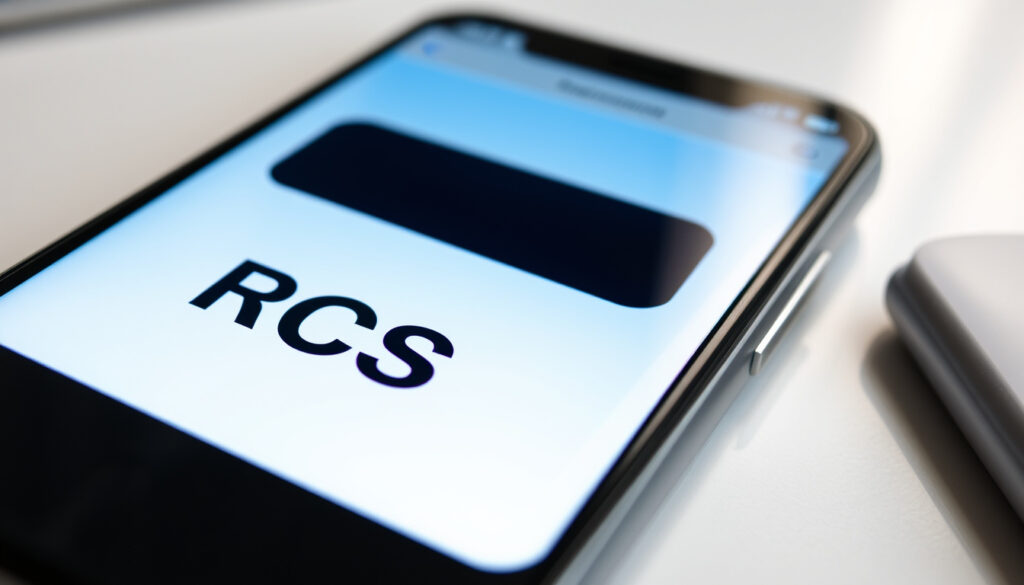
What Does Text Message RCS Mean? The Complete Guide
If you’ve ever sent a text message and noticed “RCS” appear where “SMS” used to be, you’re not alone. That small label signals a shift in how your phone handles messaging — one that brings richer features but also raises questions about cost, encryption, and compatibility.
RCS adoption on Android (2024): over 1 billion monthly active users (Google) · RCS supported by Apple: iOS 18+ (2024) · Key upgrade over SMS: Read receipts, typing indicators, high-res media · Encryption status: Not end-to-end encrypted by default (Google Messages uses E2EE)
Quick snapshot
- RCS stands for Rich Communication Services (Twilio)
- RCS supports read receipts, typing indicators, high-res images (Twilio)
- RCS requires data or Wi-Fi, not SMS plan (Apple Support)
- Apple added RCS support in iOS 18 (Apple Support)
- Whether all carriers support RCS end-to-end encryption (Twilio)
- Future adoption rate of RCS on legacy devices (Twilio)
- Exact pricing structures across carriers remain inconsistent (Twilio)
- Timeline for universal encryption standard across all platforms (Twilio)
- 2007: GSMA develops RCS standard (Twilio)
- 2019: Google adopts RCS as default for Android (Twilio)
- 2024: Apple adds RCS support in iOS 18 (Apple Support)
- 2026: Google announces cross-platform E2EE for RCS (Google Blog)
- Broader industry adoption of E2EE across carriers
- Potential replacement of SMS for most messaging
- Improved interoperability between Android and iPhone
| Label | Value |
|---|---|
| Full name | Rich Communication Services |
| Introduced | 2007 (standard); widespread adoption 2020s |
| Data requirement | Wi-Fi or mobile data |
| Default encryption (Android) | End-to-end (Google Messages) |
| Default encryption (iOS) | Not end-to-end encrypted |
| Cross-platform | Yes (Android and iOS 18+) |
What Does Text Message RCS Mean?
Rich Communication Services protocol overview
RCS stands for Rich Communication Services, a protocol developed by the GSMA in 2007 as a modern upgrade to SMS and MMS. Unlike SMS, which relies on cellular control channels, RCS uses a data network — Wi‑Fi or mobile data — to transmit messages, enabling features that feel more like a chat app than a text message. According to Twilio, RCS can support images, video, audio, files, read receipts, typing indicators, branding, buttons, carousels, and quick replies.
How RCS upgrades SMS
The shift from SMS to RCS is like moving from a postcard to a full‑color newsletter. Where SMS is capped at 160 characters (Twilio), RCS has no character limit. You can send high‑resolution photos, video clips, and participate in group chats that actually show who’s typing and when a message is read. The catch: both sender and recipient need a data connection, and RCS requires carrier and device support.
For Android users, RCS is the default messaging experience in Google Messages. For iPhone users on iOS 18, it’s a new option that bridges the gap with Android — but not without tradeoffs in encryption and carrier availability.
What Is the Difference Between RCS and SMS Texting?
Feature comparison: RCS vs SMS
Five key differences emerge between these two protocols. Here’s how they stack up:
| Feature | SMS | RCS |
|---|---|---|
| Character limit | 160 characters per message | No limit |
| Media support | Low‑res (MMS, compressed) | High‑res images, video, audio, files |
| Read receipts | No | Yes |
| Typing indicators | No | Yes |
| Delivery model | Cellular network | Data network (Wi‑Fi or mobile data) |
The implication: RCS turns plain text into a richer conversation, but it demands a data connection — something SMS doesn’t need.
Carrier support and compatibility
RCS adoption isn’t universal. On Android, Google Messages is the most common RCS client, and Twilio notes that carrier support varies. On iPhone, Apple Support states that RCS is available starting with iOS 18, but only if your carrier supports it. That means even with a compatible phone, you might not see RCS in your messaging app if your carrier hasn’t enabled it.
RCS interoperability between Android and iPhone is now possible, but encryption is not guaranteed end‑to‑end across all carriers.
Is RCS Messaging Good or Bad?
Advantages of RCS messaging
- Richer media: high‑resolution photos, videos, and audio files.
- Real‑time feedback: read receipts and typing indicators.
- Group chats that work like modern chat apps.
- No per‑message fees — uses data or Wi‑Fi.
Drawbacks and limitations
- Requires a data connection; no SMS fallback when offline.
- Not all carriers support RCS, especially for iPhone.
- Encryption is not universal — Google Messages offers E2EE for Android‑to‑Android chats, but cross‑platform E2EE is still rolling out.
Privacy and security concerns
Google announced on May 11, 2026, that end‑to‑end encrypted RCS messaging was rolling out for Android and iPhone users (Google Blog). This is a major step, but Apple’s support page notes that E2EE for RCS requires iOS 26.5 and carrier support — meaning full encryption coverage is still a work in progress. For now, if you’re using RCS on an iPhone, your messages are not encrypted by default.
The gap between what Google offers (E2EE for Android‑to‑Android RCS) and what Apple delivers (no default E2EE) creates a confusing landscape. Users who care about privacy should check which encryption standard their carrier and messaging app actually support.
Is RCS Texting Free? Does RCS Message Cost Money?
Data usage and carrier fees
RCS messages themselves are free — no per‑message carrier fee. But they use mobile data or Wi‑Fi. AWS End User Messaging documents that RCS pricing consists of an AWS message fee plus a carrier fee passed through without markup. For consumers, if you’re on an unlimited data plan, RCS costs nothing extra. If you’re on a metered plan, each RCS message consumes a small amount of data (typically a few kilobytes per text message, more for media).
Cost on iPhone vs Android
On both platforms, the cost structure is the same: no per‑message charge, but data usage applies. AWS pricing shows that RCS pricing varies by country and message type (Basic, Single, Conversation), but consumers don’t see these backend fees. The only scenario where you could pay more is if you send large media files while on a limited data plan — then carrier data overage charges may apply.
The trade-off: RCS is cheaper than SMS if you have an unlimited data plan, but more expensive if you’re paying per megabyte.
How Do You Get RCS Off Your Text Messages?
Turn off RCS on Android (Google Messages)
- Open the Google Messages app.
- Tap your profile picture or the three‑dot menu, then go to Messages settings.
- Select RCS chats (or Chat features).
- Toggle off Enable RCS chats.
Once disabled, your messages will revert to SMS/MMS. Note that you may lose read receipts and typing indicators when communicating with other RCS users.
Turn off RCS on iPhone (iOS 18+)
- Open the Settings app.
- Scroll down and tap Messages.
- Under the Text Messaging section, toggle off RCS Messaging.
After disabling, your iPhone will send messages as SMS or iMessage (depending on the recipient). Apple Support confirms that a text‑messaging plan from a carrier that supports RCS on iPhone is required to use the feature.
The pattern: turning off RCS is straightforward on both platforms, but the trade‑off is losing the richer features that made you curious about it in the first place.
Timeline: How RCS Became the New Standard
- 2007 — GSMA develops the RCS standard as a successor to SMS/MMS.
- 2019 — Google adopts RCS as the default messaging protocol for Android, pushing for wider carrier adoption.
- 2024 — Apple announces RCS support in iOS 18, marking a major step toward cross‑platform interoperability (Apple Support).
- 2026 — Google rolls out end‑to‑end encrypted RCS messaging for Android and iPhone users, a milestone for privacy (Google Blog).
What this means: RCS has moved from a theoretical standard to a real‑world feature that tens of millions of people use daily. The encryption gap is closing, but universal adoption remains a work in progress.
What We Know and What Remains Unclear
Confirmed facts
- RCS stands for Rich Communication Services (Twilio).
- RCS provides read receipts and typing indicators (Twilio).
- RCS requires data or Wi‑Fi (Apple Support).
- RCS is available on Android and iOS 18+ (Apple Support).
- Google Messages offers E2EE for Android‑to‑Android RCS (Google Blog).
What’s unclear
- Whether all carriers support RCS end‑to‑end encryption.
- Future adoption rate of RCS on legacy devices.
- Exact pricing structures across carriers remain inconsistent (Twilio).
- Timeline for universal encryption standard across all platforms.
More related posts
 Bonnie Blue 1000 Men: Documentary Record and Facts
 Yoga Studio Near Me: Cost, Frequency & Beginner Guide
 Hobby Lobby Black Friday 2026: Deals, Discounts & Store Hours
 PlayStation Plus Free Games: Monthly Lineup, Tiers & Value (2025)
 Delta Flight DL275 Diverted to LAX: What Caused the Emergency
 SSI April 2025 Payment Date: Full Schedule from SSA
 What Is Paprika Made Of? Ingredients, Myths & Facts
 Frieren: Beyond Journey’s End: Season 2, Episodes, Watch Guide
