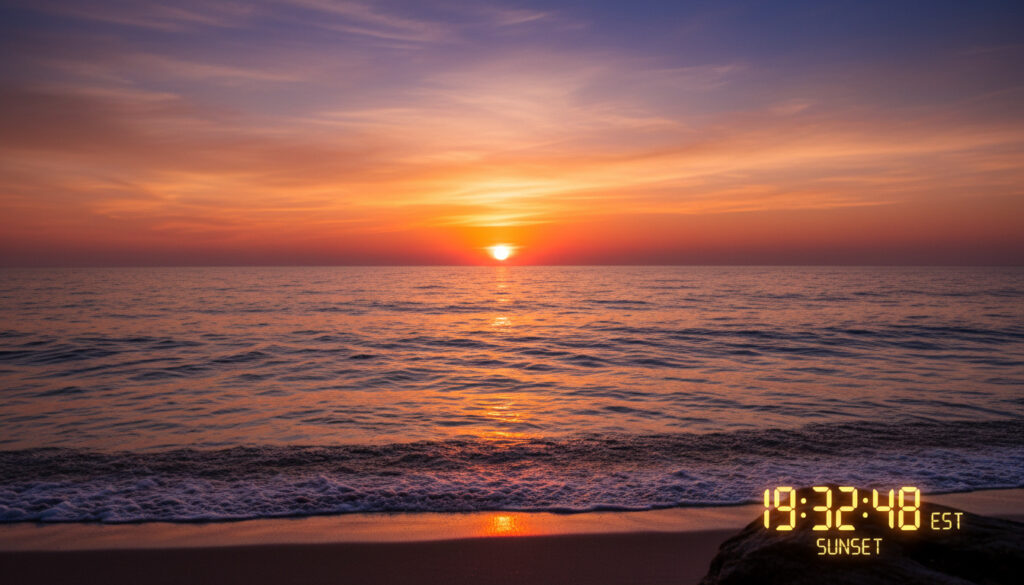
What Time Is Sunset Today – Precise Local Times & Tools
Determining what time sunset occurs today requires precise astronomical calculations specific to your geographic coordinates. Unlike universal clock times, sunset varies by latitude, longitude, elevation, and the current date within Earth’s annual orbit. Modern almanacs and digital tools calculate this moment down to the minute, accounting for atmospheric refraction that bends sunlight over the horizon.
The definition of sunset itself carries technical specificity. Astronomers define the event as the moment the sun’s upper limb disappears below the horizon, not when its center crosses. This distinction, combined with light-bending atmospheric effects, means the sun you see setting has already dropped geometrically below the horizon line.
How Can I Determine Today’s Exact Sunset Time for My Location?
Locating precise sunset times for your specific position requires either GPS coordinates or a validated city name entered into astronomical calculators. Generic time zones cover too broad an area to provide minute-accurate results, particularly for regions spanning multiple degrees of longitude.
Input GPS coordinates or city name into NOAA or USNO calculators for location-specific results.
Calculate the total daylight period between today’s sunrise and sunset events.
Identify when civil twilight ends and astronomical darkness begins after sunset.
Compare today’s daylight hours against solstice and equinox benchmarks.
Several key principles govern how sunset manifests across different locations:
- Geographic specificity: Sunset varies by latitude, longitude, and date, making location data essential for accuracy.
- Physical definition: Sunset occurs when the sun’s upper edge touches the horizon, not its center.
- Daily variation: Times change approximately 1-2 minutes daily due to Earth’s 23.5-degree axial tilt and orbital eccentricity.
- Atmospheric refraction: The visible sunset extends roughly 2 minutes longer than geometric calculations would predict due to light bending.
- Elevation impact: Altitude above sea level delays sunset by approximately one minute per 1,000 meters of elevation.
- Twilight continuation: Usable light persists through civil twilight for 20-30 minutes after official sunset.
| Fact | Details |
|---|---|
| Definition | Moment sun’s upper limb disappears below horizon (center at -0.83°) |
| Global Average Range | Varies from approximately 4:30 PM to 9:30 PM by latitude and season |
| Primary Factors | Latitude, longitude, elevation, atmospheric refraction, date |
| Calculation Tools | NOAA Solar Calculator, USNO Data Services, GPS-enabled apps |
| Refraction Effect | Standard correction of 0.83° (34 arcminutes) extends visibility |
| Elevation Adjustment | ~1 minute delay per 1,000 meters above sea level |
| Twilight Duration | Civil twilight: 0°-6° below horizon; nautical: 6°-12°; astronomical: 12°-18° |
| Solstice Variation | Longest day ~June 20-21 (Northern Hemisphere), shortest ~December 21-22 |
| Equinox Standard | March 19-21 and September 22-23 yield approximately 12 hours daylight globally |
| Daily Shift Rate | ~2 minutes/day near equinoxes; up to 24 minutes/day at 60°N latitude |
For precise NYC times and neighborhood-specific calculations, consult What Time Is Sunset Today – Precise NYC Times and Tools.
What Astronomical Calculations Determine Precise Sunset Times?
The mathematical determination of sunset relies on the sunrise equation, a formula calculating the sun’s position relative to the horizon based on Julian day number, latitude, and longitude. This equation computes the hour angle at which the sun’s center reaches the horizon, then adjusts for the sun’s angular radius and atmospheric refraction.
The Role of Latitude and Longitude
Your position on Earth’s surface determines the sun’s apparent path across the sky. Latitude affects the sun’s maximum altitude and the length of daylight, while longitude determines when solar noon occurs relative to Coordinated Universal Time. The calculation uses the formula:
Hour angle ω = arccos(cos(z) / (cos(φ)·cos(δ)) – sin(φ)·sin(δ))
Where φ represents latitude, δ represents solar declination (varying between ±23.44° seasonally), and z represents the zenith distance adjusted for refraction, according to calculations detailed in astronomical computation references.
Atmospheric Refraction and the Horizon
Earth’s atmosphere bends incoming sunlight downward by approximately 0.83 degrees when the sun sits near the horizon. Without this refraction correction, sunset predictions would err by roughly two minutes. Omnicalculator’s sunrise-sunset tool incorporates this standard adjustment, using a refraction angle of 34 arcminutes to account for the sun’s upper limb.
For locations near 60 degrees north latitude, daily sunset shifts can reach 24 minutes per day during certain seasons, requiring precise tracking for accurate forecasting.
How Do Sunset Times Vary Throughout the Year?
Earth’s elliptical orbit and axial tilt create continuous variation in sunset timing. These changes follow predictable patterns accelerating near equinoxes and slowing near solstices.
Daily and Seasonal Shifts
Near equinoxes (March and September), sunset times shift approximately two minutes later or earlier each day as the sun’s declination changes rapidly. At higher latitudes, this rate intensifies dramatically. Calculations for 60°N latitude demonstrate shifts up to 24 minutes daily during peak transition periods.
Solstices and Equinoxes
The summer solstice (June 20-21 in the Northern Hemisphere) marks the latest sunset of the year for temperate zones, while the winter solstice (December 21-22) brings the earliest dusk. During equinoxes, when the sun’s declination equals zero, day length approximates 12 hours globally, adjusted for refraction and latitude.
Mountainous terrain alters sunset timing significantly. NASA technical documentation confirms that elevation increases sunset times by approximately one minute per 1,000 meters due to reduced horizon dip and altered atmospheric density.
What Occurs During Twilight After Sunset?
Official sunset marks only the beginning of evening’s light transition. Three distinct twilight phases follow, each defined by the sun’s depth below the horizon.
Civil, Nautical, and Astronomical Twilight
Civil twilight persists while the sun remains within 6 degrees below the horizon—sufficient for outdoor activities without artificial illumination. Nautical twilight extends to 12 degrees below, when the horizon remains visible for marine navigation. Astronomical twilight continues until 18 degrees below, when the faintest stars become visible. NOAA’s solar calculator provides specific transition times for all three phases.
At latitudes above 48.5 degrees, civil twilight may persist throughout the night during summer months, while polar regions experience continuous twilight or darkness near solstices.
How Do Sunset Times Progress Through the Seasons?
The annual cycle of sunset follows Earth’s 365.25-day orbital period, creating predictable milestones:
- March Equinox: Sunset times align near 6:00 PM local time across all latitudes, with day length approximately 12 hours.
- Spring Acceleration: Daily sunset delays by 1-3 minutes as days lengthen toward summer.
- June Solstice: Latest sunset of the year occurs in the Northern Hemisphere (earliest in Southern Hemisphere).
- Summer Plateau: Sunset times stabilize briefly before reversing direction.
- September Equinox: Sunset returns to approximately 6:00 PM local time as day length equalizes.
- Autumn Regression: Sunset advances earlier by 1-3 minutes daily, accelerating at higher latitudes.
- December Solstice: Earliest sunset of the year occurs, marking the shortest day.
Data from Latlongdata’s calculator confirms these patterns remain consistent year-to-year, varying only by seconds due to orbital perturbations.
Which Aspects of Sunset Timing Are Definitive vs. Variable?
Understanding the reliability of sunset data requires distinguishing between astronomical certainties and environmental variables.
| Established Information | Information That Remains Unclear |
|---|---|
| Precise calculations via astronomy APIs calculate geometric positions to the second | Weather conditions and cloud cover may obscure the visible sunset moment |
| Official almanacs from USNO provide accuracy within seconds for clear horizons | Time zone boundaries and DST shifts create clock-time discrepancies |
| GPS coordinates provide exact location parameters for calculation | High elevations alter timing by minutes depending on local topography |
| The sunrise equation provides deterministic results for any given date | Atmospheric temperature inversions can unpredictably alter refraction |
Why Does Sunset Time Differ So Significantly by Location?
Geographic position fundamentally determines when the sun disappears from view. Near the equator, sunset varies only slightly throughout the year—typically within a one-hour window—because the sun’s path intersects the horizon at a steep perpendicular angle. At polar latitudes, the sun may skim the horizon for hours or not set at all during summer months.
Longitude creates additional variation through time zone discrepancies. A city positioned at the western edge of a time zone experiences sunset an hour later by clock time than a city at the eastern edge, despite the astronomical event occurring at the same universal time. This explains why New Balance Store Near Me – Locator, Outlets and Hours and similar location-based services rely on precise GPS rather than postal codes for accurate local timing.
Elevation compounds these effects. Observers in mountain regions witness later sunsets than coastal dwellers at the same latitude because their elevated horizon line extends farther around Earth’s curvature. CalculatorSoup’s sunrise-sunset tool includes elevation inputs to compensate for these topographical differences.
Where Do Official Sunset Calculations Come From?
Authoritative sunset times originate from governmental astronomical agencies employing standardized algorithms.
The US Naval Observatory provides the astronomical data that underlies most commercial and governmental sunset calculations, using the fundamental ephemeris developed for navigation and surveying.
— US Naval Observatory Data Services
NOAA’s Improved Sunrise/Sunset Calculator implements rigorous astronomical algorithms capable of computing solar position to within one arcminute for any location between the years 1700 and 2100.
— NOAA Global Monitoring Laboratory
What Is the Most Reliable Method to Verify Today’s Sunset Time?
For immediate accuracy, enter your specific GPS coordinates or city name into the NOAA Solar Calculator or similar astronomical tool, verifying that the selected time zone reflects your current daylight saving status. What Time Is Sunset Today – Precise NYC Times and Tools offers localized implementations for urban areas where horizon obstructions may affect visible sunset.
Frequently Asked Questions
Why does sunset time change every day?
Earth’s 23.5-degree axial tilt causes the sun’s path to shift daily, while our planet’s elliptical orbit varies its orbital speed. These factors alter when the sun’s upper limb crosses the horizon, typically changing sunset times by 1-2 minutes daily, or up to 24 minutes at high latitudes.
Does sunset time vary by elevation?
Yes, elevation delays sunset approximately one minute per 1,000 meters above sea level. Higher vantage points extend the visible horizon, allowing observers to see the sun longer than those at sea level at the same geographic coordinates.
What is the difference between sunset and dusk?
Sunset marks the moment the sun’s upper edge disappears below the horizon. Dusk, or civil twilight, continues until the sun reaches 6 degrees below the horizon—typically 20-30 minutes after sunset—when artificial light becomes necessary for outdoor activities.
How do time zones affect sunset times?
Time zones group longitudes into hour-wide bands, causing locations on the western edge to experience sunset an hour later by clock time than eastern-edge locations. Daylight Saving Time shifts these times an additional hour during summer months.
Can I calculate sunset without internet tools?
Manual calculation requires the sunrise equation using your latitude, longitude, and the current Julian day number. You must account for atmospheric refraction (0.83 degrees) and the sun’s angular radius, making manual computation complex without astronomical tables.
Why is the sunset I see later than the calculated time?
Atmospheric refraction bends sunlight over the horizon, allowing you to see the sun approximately two minutes after it has geometrically set. Additionally, elevation and clear atmospheric conditions can extend visible sunset beyond standard predictions.
More related posts
 PSG vs Inter Milan Lineups: UCL Final 2025 Starting XIs
 Nestle Chocolate Chip Cookie Recipe (1939 Original)
 Hand, Foot and Mouth Disease Treatments – Symptom Relief and Stages Guide
 Pirates of the Caribbean Movies in Order | Complete Watch Guide
 Why Is Linzess Dangerous? Key Risks & Side Effects
 ASAP Rocky Net Worth 2025: Vs Rihanna and Top Rappers
 Sydney Sweeney American Eagle Ad: Backla h, Impact, and Re pon e
 New Jurassic Park Movie – Jurassic World Rebirth Explained
