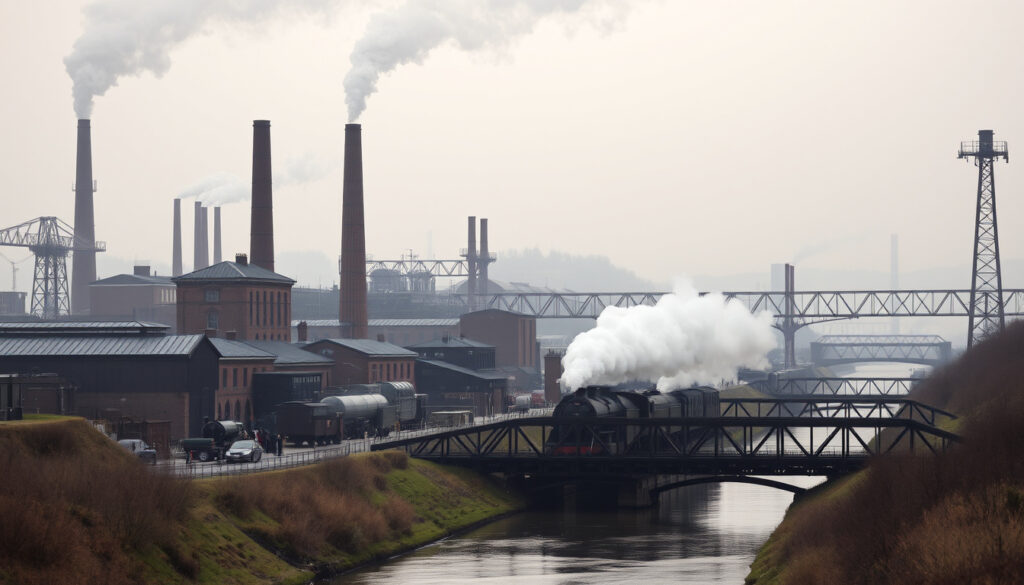
When Was the Industrial Revolution? Complete Timeline
You’ve probably seen the term “Industrial Revolution” and wondered exactly when it all started — and whether we’re still in one. The answer isn’t as simple as a single year; historians have identified four distinct industrial revolutions, each with its own timeline, defining technologies, and global shifts. This article lays out the start and end dates for each revolution, clarifies the often-blurry transition between the first and second phases, and shows where we stand today with the fourth.
Industrial Revolution start (main phase): around 1760 in Britain ·
Industrial Revolution end (traditional): around 1840 ·
Second Industrial Revolution period: approximately 1870 to 1914 ·
Third Industrial Revolution start: around 1969 (early digital) ·
Fourth Industrial Revolution (current): early 21st century onward ·
Key location of first revolution: Great Britain
Quick snapshot
- First IR started in Britain around 1760–1840 (Wikipedia — historical encyclopedia)
- Second IR began around 1870–1914 (IED — engineering education institute)
- Third IR (digital) started around late 1960s–1970s (IED — engineering education institute)
- Fourth IR is considered the current revolution (NAMC Network — manufacturing industry analysis)
- Exact start date of the first IR is debated (some scholars argue for 17th century) (The Guardian — news reporting on academic debate)
- Whether the third IR is a separate revolution or part of the second is disputed (The Guardian — news reporting on academic debate)
- The fourth IR’s naming and start date are still being refined (The Guardian — news reporting on academic debate)
- 1760: First IR begins in Britain
- 1870: Second IR begins
- 1969: Third IR begins
- 2000s: Fourth IR begins
- Fourth IR is ongoing; definitions of its endpoint are not yet settled
- Fifth IR concept (human-machine collaboration) is emerging in academic discourse
The table below compresses the key milestones into a single reference.
| Item | Value |
|---|---|
| First IR start year | around 1760 |
| First IR end year | around 1840 |
| Second IR start year | around 1870 |
| Third IR start year | around 1969 |
| Fourth IR start year | early 21st century |
| Primary first IR location | Great Britain |
When was the first and second industrial revolution?
First Industrial Revolution dates (1760–1840)
- The first Industrial Revolution began in Great Britain around 1760, marked by the mechanization of textiles and the development of steam power (Wikipedia — historical encyclopedia).
- James Hargreaves conceived the spinning jenny in about 1764, which was patented in 1770 (Britannica — academic reference publisher).
- James Watt patented his improved steam engine in 1769, a pivotal development (Britannica — academic reference publisher).
- Richard Arkwright first used Watt’s steam engine to power textile machinery in the 1770s (Britannica — academic reference publisher).
- Samuel Crompton invented the spinning mule in 1779 (Britannica — academic reference publisher).
- John Kay’s flying shuttle, invented earlier in 1733, greatly sped up weaving (Historic UK — British history publisher).
Second Industrial Revolution dates (1870–1914)
- The second Industrial Revolution began around 1870 and is characterized by steel, electricity, and mass production (IED — engineering education institute).
- The Bessemer process for steel production was invented around 1856, laying the groundwork (Centre of Excellence — educational platform).
- The electric telegraph, invented around 1837, became a key communications technology (Centre of Excellence — educational platform).
- This period also saw the rise of the combustion engine and assembly-line production (NAMC Network — manufacturing industry analysis).
The transition between the first and second revolutions is not a sharp break; some historians see overlapping phases. The first IR ended around 1840, but the innovations in steam and iron continued to evolve, leading to the steel-and-electricity era that began in the 1870s.
The pattern: each revolution spilled into the next, with the first establishing mechanization and the second building entirely new industries around steel and electricity.
The common confusion between the first and second IR stems from their gradual transition. The first IR was about mechanizing existing processes with steam and water; the second was about creating entirely new industries around steel, electricity, and chemical engineering. For students and history buffs, the key dates to remember are 1760 (first IR start) and 1870 (second IR start).
When did the Industrial Revolution start and end?
Start: 1760s in Britain
- Textile machinery (spinning jenny, water frame) emerged in the 1760s–1780s (Britannica — academic reference publisher).
- High growth in steam power and iron production occurred after 1800 (Centre of Excellence — educational platform).
- The very first sparks came earlier, with John Kay’s flying shuttle in 1733 (Historic UK — British history publisher).
End: around 1840 (traditional end of first IR)
- Many historians consider the first Industrial Revolution to have ended around 1840 (Centre of Excellence — educational platform).
- The period is also sometimes dated 1750–1830 for the British phase (Northwood University — educational institution).
- Key inventions continued into the 1840s, including Cyrus McCormick’s mechanical reaper in 1834 and Elias Howe’s sewing machine in 1846 (Britannica — academic reference publisher).
The first IR is defined by the shift from hand production to machines, primarily in Britain. Its end around 1840 is a broad convention; the technologies it introduced continued to improve well into the 1850s and 1860s.
The implication: the “end” of the first revolution was a gradual fade, not a hard stop — the steam-powered world it built kept running.
What is the 1st, 2nd, and 3rd Industrial Revolution?
First: Mechanization (steam, textile mills)
- Water and steam power, mechanized factories (late 18th century) (Wikipedia — historical encyclopedia).
- Key inventions: spinning jenny (1764), steam engine (1769), spinning mule (1779), power loom (1785) (Britannica — academic reference publisher).
- First locomotive railway journey by Trevithick in 1804 in Merthyr Tydfil, Wales (Historic UK — British history publisher).
Second: Mass production (electricity, steel)
- Assembly line, electricity, chemical industry (late 19th century) (IED — engineering education institute).
- Bessemer steel process (1856), electric telegraph (1837), combustion engine (Centre of Excellence — educational platform).
- Edwin Drake drilled first productive US oil well in 1859 near Titusville, Pennsylvania (Britannica — academic reference publisher).
Third: Digital (computers, automation)
- Electronics, computers, internet (late 20th century) (IED — engineering education institute).
- The third revolution is generally considered to have started around 1969–1970s with the rise of digital electronics (IED — engineering education institute).
- Term ‘Third Industrial Revolution’ is used to describe the shift from analog to digital systems (NAMC Network — manufacturing industry analysis).
The three revolutions represent a clear progression: from harnessing steam (1st), to mastering energy and materials (2nd), to processing information at scale (3rd). Each builds on the last; the third IR’s digital foundation makes the fourth possible.
What this means: the third revolution was the bridge from physical power to information power — without it, the fourth couldn’t exist.
When did the third industrial revolution start?
Third Industrial Revolution (Digital Revolution) began in the late 1960s to 1970s
- The third revolution is generally considered to have started around 1969–1970s with the rise of digital electronics and early computing (IED — engineering education institute).
- This period saw the development of the first microprocessors, the internet’s precursor (ARPANET, 1969), and early programmable logic controllers.
- Automation of factories accelerated as computers took over tasks previously done by human operators (NAMC Network — manufacturing industry analysis).
The third IR’s start is often linked to 1969, the year ARPANET sent its first message and the first microprocessor was developed. However, the full transition from analog to digital took decades, continuing through the 1980s and 1990s.
The implication: 1969 is the symbolic birth year of the digital age, but the revolution didn’t reach most people’s homes until personal computers arrived in the 1980s.
For anyone born after 1970, the third IR is the backdrop of everyday life: the shift from typewriters to word processors, from landlines to smartphones, from maps to GPS. Understanding its start year (1969) helps distinguish it from the earlier revolutions that were about physical power rather than information processing.
Are we in the fourth industrial revolution?
Fourth Industrial Revolution: Cyber-physical systems, AI, IoT (early 21st century)
- The fourth IR began around 2000s–2010s with the fusion of digital, biological, and physical worlds (NAMC Network — manufacturing industry analysis).
- Characterized by artificial intelligence, robotics, Internet of Things, and biotechnology (World Economic Forum — global policy and economics institute).
- Widely considered the current revolution, as recognized by the World Economic Forum in the 2010s (World Economic Forum — global policy and economics institute).
- Klaus Schwab, executive chairman of the WEF, popularized the term ‘Fourth Industrial Revolution’ in his 2016 book (World Economic Forum — global policy and economics institute).
Yes, we are in the fourth industrial revolution. It began around 2000 but accelerated dramatically after 2010 with the explosion of AI, cloud computing, and IoT devices. Unlike previous revolutions that took decades to unfold, the fourth IR is evolving rapidly, and its endpoint is not yet in sight.
The catch: the fourth revolution’s speed means its full impact on work, ethics, and global power is still unknown.
Where and when did the Industrial Revolution start?
Started in Great Britain, historically dated to the 1760s
- Great Britain (especially England, Scotland, and Wales) was the birthplace of the IR due to abundant coal, iron deposits, and colonial trade networks (Wikipedia — historical encyclopedia).
- Early mechanized textile mills appeared in the 1760s, with the spinning jenny (1764) and water frame (1769) (Britannica — academic reference publisher).
- James Watt’s steam engine improvements in the 1770s accelerated the revolution (Britannica — academic reference publisher).
- First large-scale Luddite riot occurred in 1811 in Arnold, Nottingham, as workers protested against mechanization (Historic UK — British history publisher).
Britain had the right mix of resources, capital, and infrastructure to kickstart the revolution. The first spark was in the textile industry, but it quickly spread to iron, coal, and transport, transforming the country and eventually the world.
What this means: Britain’s coal and iron deposits were the physical fuel for the revolution, but its colonial trade networks provided the capital that made large-scale investment possible.
What was the industrial age (1700 to 1930)?
The broad period from early industrialization through the end of the Second Industrial Revolution
- The term ‘industrial age’ often refers to the era from early 1700s (pre-Industrial Revolution) to the 1930s (Wikipedia — historical encyclopedia).
- This period includes the first two industrial revolutions: mechanization (first IR) and mass production (second IR) (Centre of Excellence — educational platform).
- It ended with the Great Depression and the rise of the digital age (third IR) (IED — engineering education institute).
- By the 1930s, mass production, electricity, and chemical industries had become standard, setting the stage for digital transformation.
The ‘industrial age’ is a broad umbrella covering roughly 230 years of history. It encompasses the shift from an agrarian society to one dominated by factories, cities, and large-scale industry. The digital age that followed (the third IR) represented a fundamental break, as information rather than physical goods became the primary driver of economic growth.
The implication: the industrial age was a long wave that peaked in the early 20th century and then gave way to an information-driven economy.
Comparison table: The four industrial revolutions
Eight decades, four revolutions, one pattern: each revolution is defined by a breakthrough in how energy, materials, or information are controlled.
| Revolution | Period | Key technologies | Main regions |
|---|---|---|---|
| First | 1760–1840 | Steam power, textile machinery, iron production | Great Britain |
| Second | 1870–1914 | Electricity, steel, chemicals, assembly line | US, Germany, Britain |
| Third | 1969–2000 | Digital electronics, computers, internet, automation | Advanced economies worldwide |
| Fourth | 2000s–present | AI, robotics, IoT, biotechnology, cyber-physical systems | Global |
Timeline
- 1760: First Industrial Revolution begins in Britain (textile machinery, steam engine refinement) (Britannica — academic reference publisher).
- 1840: First Industrial Revolution ends (traditional dating) (Centre of Excellence — educational platform).
- 1870: Second Industrial Revolution begins (steel, electricity, chemicals) (IED — engineering education institute).
- 1914: Second Industrial Revolution ends (start of World War I) (NAMC Network — manufacturing industry analysis).
- 1969: Third Industrial Revolution begins (digital computers, early internet) (IED — engineering education institute).
- 2000s: Fourth Industrial Revolution begins (AI, IoT, cyber-physical systems) (World Economic Forum — global policy and economics institute).
Clarity section
Confirmed facts
- First IR started in Britain around 1760–1840 (general consensus) (Wikipedia — historical encyclopedia).
- Second IR started around 1870–1914 (broad agreement) (IED — engineering education institute).
- Third IR (digital) started around late 1960s–1970s (IED — engineering education institute).
- Fourth IR is considered the current revolution (World Economic Forum — global policy and economics institute).
What’s unclear
- Exact start date of the first IR is debated (some scholars argue for 17th century) (The Guardian — news reporting on academic debate).
- Whether the third IR is a separate revolution or part of the second is disputed.
- The fourth IR’s naming and start date are still being refined.
Quotes
“The Industrial Revolution was the most significant event in the history of humanity since the domestication of animals and plants.”
— Historian J. R. McNeill, environmental history specialist
“We are at the beginning of a revolution that is fundamentally changing the way we live, work, and relate to one another.”
— Klaus Schwab, founder and executive chairman of the World Economic Forum (WEF — global policy and economics institute)
“Some historians date the start of the Industrial Revolution to the 17th century, not the 18th, based on early coal use and trade networks.”
— The Guardian (news reporting on academic debate)
Summary: The industrial age and today
The four industrial revolutions trace a clear arc from steam and steel to silicon and software. Each phase dramatically reshaped societies, economies, and daily life. The first gave us factories and railways; the second gave us electricity and mass production; the third gave us computers and the internet; and the fourth is giving us AI and cyber-physical systems. For anyone trying to understand the present moment, the key takeaway is that the fourth revolution is still in its early stages — and its full impact on work, ethics, and global power is yet to be determined.
Related reading: How Many Working Days in a Year · St. Francis of Assisi Facts Miracles
Frequently asked questions
When did the Industrial Revolution end in Britain?
The first Industrial Revolution is traditionally said to have ended around 1840 in Britain, though the second revolution began around 1870. Some historians use 1750–1830 as the specific British phase (Northwood University — educational institution).
How long did the first Industrial Revolution last?
Approximately 80 years, from 1760 to 1840 (Centre of Excellence — educational platform).
What was the main industry during the first Industrial Revolution?
Textile manufacturing was the primary industry, driven by inventions like the spinning jenny (1764) and the power loom (1785) (Britannica — academic reference publisher).
What is the difference between the first and second Industrial Revolution?
The first focused on steam power and mechanization of textiles; the second centered on electricity, steel, and mass production. The first was largely a British phenomenon; the second spread to the US and Germany (IED — engineering education institute).
Did the Industrial Revolution start in the 17th century?
Some scholars argue for a 17th-century start, citing early coal use and trade networks. However, the mainstream consensus places the start around 1760 (The Guardian — news reporting on academic debate).
What inventions were made during the third Industrial Revolution?
The third revolution brought the microprocessor (1971), the personal computer (1970s), the internet (ARPANET, 1969), and early automation technologies (IED — engineering education institute).
How is the fourth Industrial Revolution different from the third?
The third was about digitization (computers, internet); the fourth is about integration of digital, biological, and physical systems (AI, IoT, robotics, biotech). The fourth builds on the third but creates a more deeply connected and autonomous world (World Economic Forum — global policy and economics institute).
More related posts
 Who Drafted Shedeur Sanders? Browns Pick QB in 5th Round
 49ers vs Colts Match Player Stats: 48-27 Final Score
 Purina ONE Dog Food: Reviews, Quality & Vet Advice
 John Bell (Scottish Actor): Biography, Age & Career
 Korean Food Near Me: Best Authentic Spots in Ireland Guide
 When Does McDonald’s Breakfast End? (2025 Hours Guide)
 Hand, Foot and Mouth Disease Treatments – Symptom Relief and Stages Guide
 Best Shows on Apple TV (2026): Top-Rated Series to Watch Now
