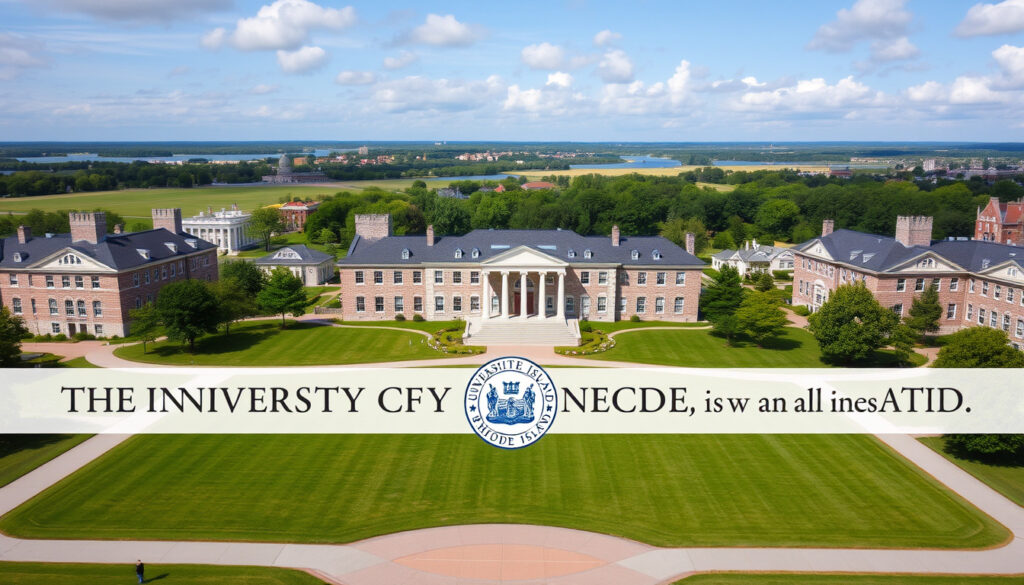
University of Rhode Island: Prestige, Rank & Acceptance Rate
There’s a curious mismatch between the University of Rhode Island’s regional reputation and its national standing. The Wall Street Journal ranks it the No. 1 public university in New England, yet it lands well outside the top 100 nationally — a tension that makes it a useful case study in how “prestige” really works for a public research university. This article examines URI’s ranking, selectivity, and what your options actually look like.
Acceptance rate: 76% (2023) ·
US News ranking (National Universities): #151 (2024) ·
WSJ ranking (Public NE): No. 1 (2026) ·
Annual in-state tuition & fees: $16,408 (2024–25) ·
Total undergraduate enrollment: ~14,000 (2023)
Quick snapshot
- Public, land-grant, R1 research university (URI News (official press release))
- Founded in 1892 as Rhode Island College of Agriculture and Mechanic Arts (Wikipedia (URI profile))
- WSJ ranks it No. 1 public university in New England (2026) (URI News (university press coverage))
- The exact phrasing of WSJ’s ranking methodology and whether it weights all New England states equally (URI News (acknowledging ranking detail))
- Whether URI’s R1 status will meaningfully shift its national ranking over the next several cycles (URI News (R1 announcement))
- Future applicant pool size and selectivity trend beyond the record 28,036 applications for fall 2025 (URI News (application record))
- February 2025: URI achieves Carnegie R1 classification, the highest research designation (URI News (R1 milestone))
- October 2025: URI ranked No. 1 public university in New England by Wall Street Journal for the second consecutive year (URI News (WSJ ranking))
- URI expects continued application growth driven by R1 prestige and regional recognition (URI Features (university narrative))
- National rankings may improve if the university leverages its research investment into higher US News scores (U.S. News (profile context))
Seven key numbers that frame URI’s identity, from its origins to its current costs.
| Attribute | Value |
|---|---|
| Founded | 1892 as Rhode Island College of Agriculture and Mechanic Arts |
| Campus size | 1,245 acres in Kingston, RI |
| Total enrollment | Approximately 17,000 (all levels) (URI Features (enrollment data)) |
| Tuition (in-state) | $16,408 (2024–25) (College Board BigFuture (tuition data)) |
| Tuition (out-of-state) | $33,862 (2024–25) (Peterson’s (tuition data)) |
| Endowment | About $140 million (2023) (Niche (endowment data)) |
| Colors | Navy blue and white |
How prestigious is the University of Rhode Island?
URI’s national ranking and reputation
URI holds a #151 spot among National Universities in the 2024 edition of U.S. News & World Report (U.S. News (ranking data)). That places it firmly in the middle tier of American four-year public universities. By comparison, top public flagships like UCLA (#15) or the University of Michigan (#21) sit in a different stratosphere. But URI’s regional reputation tells a different story.
For a student who values regional recognition and growing research investment, URI punches above its national rank. But for those chasing national brand power, the gap between #151 and the Ivy League is vast.
No. 1 public university in New England (WSJ)
The Wall Street Journal’s 2026 ranking places URI as the No. 1 public university in New England, tied to a #76 overall position nationally (URI News (WSJ ranking coverage)). The ranking methodology emphasizes student outcomes, including graduation rates and post-graduate salaries, rather than input measures like selectivity. That distinction matters: URI’s graduation rate of around 66% (URI official site (student outcomes)) is competitive for a public university but not elite. Still, for families in Connecticut, Massachusetts, and the rest of New England, URI’s top regional flag carries real weight.
“No. 1 in New England” sounds more exclusive than it is when you remember New England has only a handful of major public flagships — UMass Amherst, UConn, Vermont, New Hampshire, and Maine. URI’s lead is genuine but the field is small.
The implication: URI’s prestige is strong regionally but modest nationally. Its R1 research designation, earned in 2025, adds academic credibility that may nudge future rankings upward.
Is the University of Rhode Island a good school?
Academic strengths and notable programs
URI is an R2 research university that recently achieved R1 status (Carnegie Classification), placing it among the top doctoral universities for research activity (URI News (R1 announcement)). The university is particularly known for its College of Nursing, Graduate School of Oceanography, and political science program (URI official site (academic programs)). It offers over 200 undergraduate and graduate degree programs (URI official site (academics overview)). Student-faculty ratio is 16:1 (Wikipedia (URI profile data)), and 43.1% of classes have fewer than 20 students (Wikipedia (class size data)).
Student outcomes and satisfaction
Freshman retention rate stands at 84% (Wikipedia (retention data)), meaning most first-year students choose to return. Graduation within six years is about 66%, competitive for a public university but below flagship peers like UConn (83%) or UMass Amherst (78%) (U.S. News (grad rate context)). Student reviews often highlight the campus community and the university’s location near the ocean (Niche (student reviews)).
The pattern: URI delivers solid outcomes for a public school, especially in nursing and oceanography, but its overall graduation rate trails higher-ranked peers in the region.
Are Rhode Island schools Ivy League?
URI and the Ivy League
No. URI is not an Ivy League school. The Ivy League is an athletic conference and an informal brand comprising eight private institutions: Brown, Columbia, Cornell, Dartmouth, Harvard, Penn, Princeton, and Yale (Brown University (official site)). Rhode Island’s only Ivy League member is Brown University in Providence. URI is a public land-grant university with a separate mission, open admissions (moderately selective), and a significantly lower cost.
Why this matters: The confusion is understandable — Rhode Island is small, URI and Brown share a state, and both are high-quality institutions. But the difference in selectivity, endowment, and national brand is enormous. URI’s acceptance rate is ~76%; Brown’s is ~5%.
How hard is it to get into the University of Rhode Island?
URI acceptance rate and selectivity
URI’s acceptance rate hovers around 76% according to College Board BigFuture (admissions data), which reports 26,987 applicants, 19,475 admitted, and 2,995 enrolled for a recent cycle. Peterson’s (college database) and Niche (college profile) give similar figures (72–73%). That places URI in the “moderately selective” category. The university received a record 28,036 applications for fall 2025 (URI News (application record)), suggesting selectivity may tighten as demand grows.
Average GPA and test scores of admitted students
Admitted students typically have a high school GPA between 3.5 and 3.7 (College Board BigFuture (GPA range)). SAT and ACT scores are optional; those who submit scores average about 1140–1280 on the SAT (U.S. News (test score data)). The test-optional policy widens the applicant pool, which partly explains the surge in applications.
A 76% acceptance rate means URI is accessible to most B-average students. But with applications rising fast, that number could slip below 70% within a few years. For students hoping to secure a spot, applying early and maintaining a strong GPA is smart.
The pattern: URI remains accessible now, but its rising profile may tighten admissions.
What is the University of Rhode Island known for?
Top academic programs and degrees
URI’s strongest programs include the College of Nursing, which has a high NCLEX pass rate; the Graduate School of Oceanography, a world-renowned research institute; and political science, which consistently produces competitive graduates (URI official site (academic strengths)). For a comprehensive list, URI offers more than 200 majors and minors (URI official site (majors)).
Research strengths: oceanography, nursing, political science
URI’s R1 designation signals a major commitment to research. The university’s location on Narragansett Bay gives its oceanography program a natural advantage. Nursing benefits from partnerships with regional hospitals, and political science has a strong record of placements in government and law.
The takeaway: URI is not a one-trick school. While oceanography is its flagship, nursing and political science also draw strong student interest and produce solid career outcomes.
Certainty and uncertainties
Confirmed facts
- URI is a public land-grant R1 research university (URI News (R1))
- WSJ ranked URI No. 1 public university in New England in 2026 (URI News (WSJ ranking))
- URI is not an Ivy League school (Brown University (Ivy League membership))
- Acceptance rate is around 76% (College Board BigFuture (admissions data))
- It achieved R1 classification in February 2025 (URI News (R1 milestone))
What’s unclear
- Exact phrasing of WSJ ranking methodology for the New England category (URI News (ranking context))
- Whether R1 status will boost national rankings in the next 3–5 years (URI News (R1 announcement))
- Future selectivity trend given the record 28,036 applications (URI News (application record))
- Comparisons with other New England public flagships (UConn, UMass) on outcome metrics not yet standardized (U.S. News (overall comparison))
- The exact methodology behind US News rankings for URI is not publicly detailed (U.S. News (methodology))
“URI is once again ranked No. 1 public university in New England among the nation’s best by the Wall Street Journal.”
— URI News (official ranking announcement)
“We are proud to join the ranks of the nation’s top research universities with our new Carnegie R1 classification, a direct result of the world-class work happening across our campus.”
— URI News (R1 announcement quote from President Marc Parlange)
For prospective students weighing URI against other New England public flagships like UConn or UMass, the choice comes down to priorities. If regional recognition and research investment matter most, URI’s trajectory is strong. But if national brand power is the goal, the Ivy League mismatch and mid-tier national rank may shift the calculus. For out-of-state families, the $33,862 annual tuition makes URI comparable to other mid-tier public flagships, but its No. 1 regional ranking may tip the balance toward choosing Rhode Island over higher-priced alternatives.
uri.edu, usnews.com, facebook.com, timeshighereducation.com, reddit.com
Frequently asked questions
Is University of Rhode Island a public or private school?
URI is a public land-grant research university, founded in 1892. It is Rhode Island’s flagship public institution.
Does URI have a football team?
Yes, URI competes in NCAA Division I as the Rams. The football team plays at Meade Stadium in Kingston.
What is the graduation rate at URI?
The six-year graduation rate is approximately 66%, and the freshman retention rate is about 84%.
How many students attend URI?
Total enrollment is about 17,000 across all levels, with roughly 14,000 undergraduates.
Is URI a party school?
URI has been characterized by some as having an active social scene, but rankings and student surveys indicate a balanced academic environment.
Does URI offer online degrees?
Yes, URI offers a number of online undergraduate and graduate programs through its URI Online platform.
What is the average class size at URI?
Over 43% of classes have fewer than 20 students, with a student-faculty ratio of 16:1.
More related posts
 49ers vs Colts Match Player Stats: 48-27 Final Score
 Fantastic Four Box Office – Every Film Ranked by Earnings
 A Good Girl’s Guide to Murder: Age Rating & Spice Guide
 Form I-9: Employment Eligibility Verification Guide (2026)
 Best Salchipapas Near Me: Find Latin American Street Food
 How Many Working Days in a Year? 2025 Country Guide
 Spotify Web Player: Features, Benefits & How-To
